

JUNE 1, 1950: COURAGE & CONSCIENCE: MARGARET CHASE SMITH

Note: Another speech worth recalling and repeating. I once taught a public speaking class for high school freshman. After we studied Martin Luther King’s “I Have A Dream” speech, we took a field trip to the Lincoln Memorial to recite it on the spot. Inscribed inside the memorial are Lincoln’s Gettysburg Address and Second Inaugural (“with malice toward none”).
To honor our 250th anniversary, the University of Virginia’s Lifelong Learning Program offers a free, online “docuseries,” SPEAKING OF AMERICA, which discusses the speeches that changed and advanced our democracy. One segment focuses on Margaret Chase Smith’s “Declaration of Conscience,” delivered on June 1, 1950.
Once again, on June 1, Heather Cox Richardson has written about Senator Smith’s historic speech. While I assume maybe .001% of Heather Cox Richardson’s readers follow PINK THREADS, I’m confident 99% of my readers are fans of LETTERS FROM AN AMERICAN. I’m not copycatting. It’s understandable that, in the present moment, two historians would focus on the courage to confront a bully. I aspire to be the HCR of women’s history on Substack. I only need two million more readers.
Seventy-six years ago today, freshman Senator Margaret Chase Smith (R-Maine) reprimanded her Republican colleague, Wisconsin Senator Joseph McCarthy, without mentioning his name. In February 1950, “Tail Gunner Joe” had claimed, without evidence, that Communists and homosexuals had infiltrated the State Department. Subsequent assertions put the number at 205 or 57 or 81.
In the aftermath of World War II, Americans were unnerved by the spread of communism. Beginning in 1947, the House Un-American Activities Committee (HUAC) campaigned against liberals and left-wingers, in unions and universities, Hollywood and the State Department. In 1950, Congress passed the McCarran Internal Security Act, requiring that “subversives” submit to government supervision. When President Truman said it “would make a mockery of our Bill of Rights,” Congressional Republicans overrode his veto.
Like Smith, McCarthy were first-term Senator. Originally a Democrat, he changed parties and defeated the revered incumbent, Robert La Follette, Jr., in the Republican primary and demolished the Democrat by attacking his war record. McCarthy was a Marine, but the public did not know he only flew as an observer on twelve noncombat missions in the Pacific. He earned his nickname by shooting at coconut trees. Until his anti-communism campaign rocketed him to fame in 1950, he had not distinguished himself. Voters found him brash but authentic.
Equally opposed to communism, Smith was offended by McCarthy’s exaggerations and lack of evidence. She anticipated someone more senior would speak up. When no one did, Smith rose, with McCarthy looming two rows behind her. She called on the Senate to do “some soul-searching . . . about a serious national condition.”
Those of us who shout the loudest about Americanism . . . are all too frequently those, who by our own words and acts, ignore some of the principles of Americanism –the right to criticize; the right to hold unpopular beliefs; the right to protest; the right of independent thought. [Political discourse has been] debased to the level of . . . hate and character assassination, sheltered by the shield of congressional immunity. . .
[Exercising those rights] should not cost one single American citizen his reputation or his right to his livelihood.The American people are sick and tired of being afraid to speak their minds lest they bepolitically smeared as “Communists” or “Fascists” . . . Freedom of speech is not what itused to be in America . . . It has been so abused by some that it is not exercised byothers. . .
I speak as a Republican. I speak as a woman. I speak as a United States Senator. I don’twant to see the Republican Party ride to a political victory on the four horsemen of calumny – fear, ignorance, bigotry, and smear.
She called her speech “A Declaration of Conscience.”
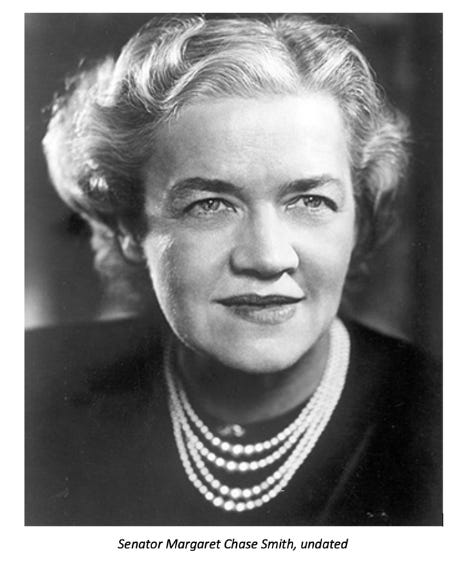
Rather than rebut her remarks, McCarthy left the chamber. Her declaration attracted only six cosigners, whom McCarthy ridiculed as “Snow White and the Six Dwarves.” He had her removed from key committees and supported her primary challenger in 1954.
The speech put Smith on the cover of Newsweek, with the question, “A Woman Vice President?” Pundits commented that, had she been a man, she could be president. But party leaders denied her a speaking slot at the 1952 convention. Asked by a reporter what she would do if she woke up in the White House, Smith replied, “I’d go straight to Mrs. Truman and apologize.”
Smith’s speech did little to restrain McCarthy. Reelected in 1952, he chaired the Committee on Government Operations, where his investigations were more aggressive and erratic. “McCarthyism” became a synonym for witch-hunting, prompting playwright Arthur Miller to write The Crucible, about the 1692 Salem witch trials.
Supported by the Catholic Church and the Kennedy family, McCarthy launched a “Lavender Scare” against homosexuals, claiming a connection between so-called sexual perversion and communist depravity. Assisted by legal counsels Roy Cohn and Robert Kennedy, McCarthy intimidated suspects, pressured people to testify and blacklisted others. More people lost their jobs charged with homosexuality than with communist sympathies.
Politicians were reluctant to risk backlash from his base. CBS journalist Edward R. Morrow was bolder, airing an expose of McCarthy and his methods on March 9, 1954, that contributed to his downfall. That episode of “See It Now” was the basis of both a 2005 movie and its 2025 Broadway adaptation, Good Night, and Good Luck.
Finally, in April 1954, McCarthy attacked the Army in televised hearings. The country had never seen him relentlessly bully and insult witnesses. Ervin Griswold, dean of Harvard Law School, described McCarthy as “judge, jury, prosecutor, castigator, and press agent, all in one.” The Army hired Boston attorney Joseph Welsh as its chief counsel. On June 9, when McCarthy browbeat a young lawyer, Welch thundered, “Have you no decency, sir?”
The Senate finally acted. In a rare measure, four years after Smith’s speech, it condemned McCarthy for “inexcusable . . . reprehensible. . . vulgar and insulting” behavior, “unbecoming a senator,” and voted 67 to 22 to censure him. Ostracized by his colleagues and ignored by the press, he increased his drinking. His biographers have struggled with rumors, and FBI files, purporting that McCarthy was both a homosexual and a serial sexual predator. In 1953, he married a researcher in his office. In January 1957, with the help of Catholic Cardinal Francis Spellman, they adopted an infant daughter. McCarthy died in May 1958, age 48.
Senator John F. Kennedy (D-MA) was hospitalized and unable to cast a censure vote. Because he never denounced McCarthyism, Eleanor Roosevelt refused to endorse JFK for vice president in 1956 or president in 1960.
Margaret Chase Smith was vindicated, but she was too much of a Mainer to gloat. Born in 1897 in Skowhegan, she was the oldest of six children of a barber and a shoe factory worker. At thirteen she took a job in a five-and-dime. After high school, she worked as an elementary school teacher, telephone operator, newspaper circulation manager and office manager at a woolen mill. She never attended college.
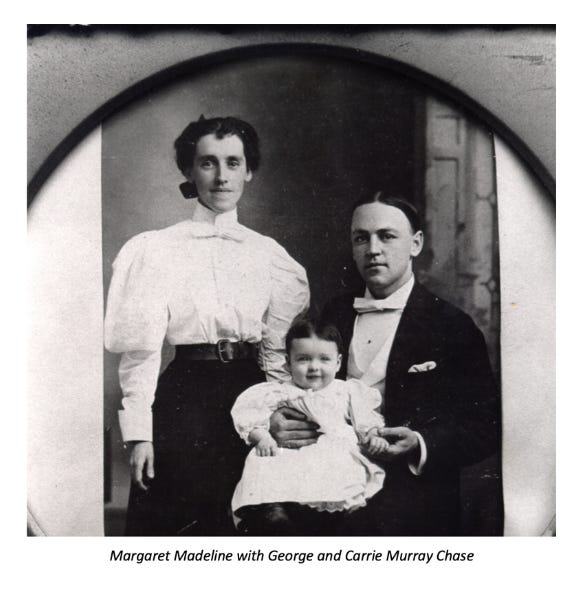
At thirty-two, she married Clyde Smith, a newspaper publisher and local politician, twenty-two years her senior. When he was elected to Congress in 1936, she was president of the Maine Business and Professional Women’s Club. She managed his Congressional office and wrote his speeches, as an unpaid volunteer. A Depression-era law barred women from federal jobs if their husbands were employed.
Congressman Smith’s New York Times obituary does not give his cause of death. His Congressional biography lists heart failure. Another source suggests that the womanizer died of advanced syphilis. The day before he died, in April 1940, he urged his constituents to support his wife.
Over the next seven months, the widow Smith won four elections: a May Republican primary, by a ten-to-one margin; a June special election without a Democratic challenger, to fill the unexpired term; a June GOP primary for the full term, amassing four times more votes than her closest competitor; and the November general election, which she secured with 65% of the vote. Referring to the 1939 movie starring Jimmy Stewart, Maine voters formed “Mrs. Smith Goes to Washington” clubs.
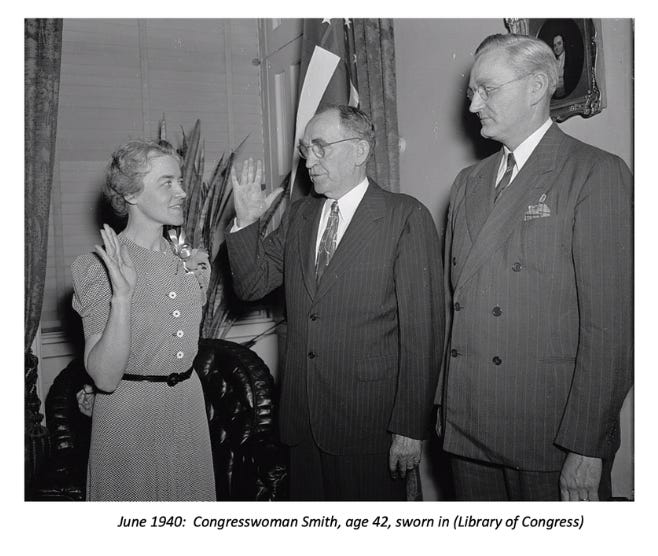
Margaret Chase Smith was the first woman elected to Congress from Maine, the first woman elected to both houses of Congress, the first Republican woman to serve in the Senate and the first female Senator whose husband had not previously held the seat. She lost her first election in 1972, at age seventy-four. Her thirty-three-year Capitol Hill tenure was eventually surpassed by Maryland Democrat Barbara Mikulski’s forty-year run.
In her first full term, 1941-43, there were ten women serving: Senator Hattie Caraway (D-Arkansas) and nine women in the House (4D, 5R). When she left in 1972, she was one of two women Senators (1D, 1R), serving with thirteen Congresswomen (10D, 3R). As the only female Senator for twelve years, she used the public restroom. She never accepted an invitation to a White House dinner until Jacqueline Kennedy suggested she bring an escort.
Smith did not consider herself a feminist. She thought women brought certain “sensibilities” to office, “for the betterment of social conditions of the masses. Women are needed in government for the very traits of character that some people say disqualify them.” On the rare occasions the Equal Rights Amendment reached a floor vote, Smith supported it, but refused to make gender an issue. “If we are to claim and win our rightful place . . . on an equal basis with men, then we must not insist upon those privileges and prerogatives identified in the past as exclusively feminine.”
Representing an isolationist, ship-building state, in 1940 Smith supported military preparedness, Lend Lease and extension of the draft. She served on the House Naval Affairs Committee, where she introduced legislation to create the Navy WAVES (Women Accepted for Voluntary Emergency Service). Not allowed to serve on ships or overseas, WAVES worked as aviation mechanics, clerks, control tower operators, medics and parachute riggers. They taught gunnery and aerial photography and tested planes in wind tunnels. Secretary of Navy James Forrestal admitted Black women to the WAVES in 1944.
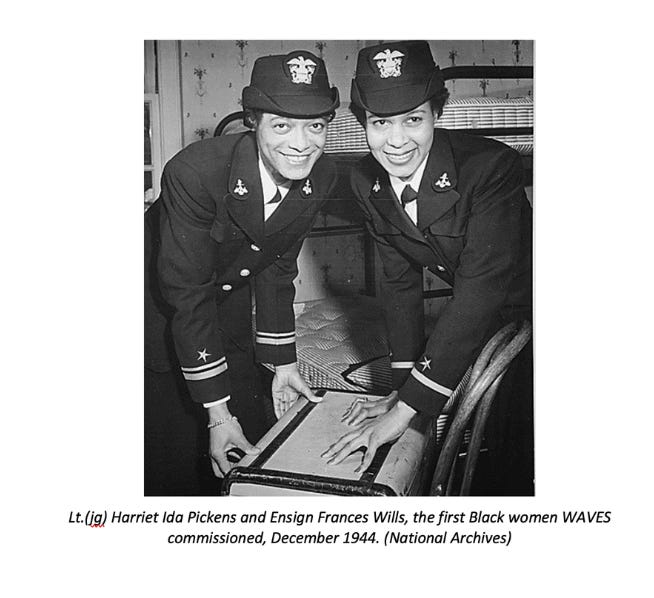
The 350,000 wartime WAVES, while paid, were considered volunteers without benefits. In 1947, as chair of a House Armed Services’ subcommittee, Smith authored a bill giving service status to Navy and Army nurses. To extend benefits to all uniformed women, the Senate passed the Armed Services Integration Act. The full House Armed Services committee curtailed female benefits, over Smith’s lone dissent. With the support of Secretary Forrestal, Smith’s original bill prevailed in the conference committee in July 1948.
That year Smith entered Maine’s hotly contested Senate primary, for an open seat. Because she was not considered a party loyalist, the Maine GOP supported the governor in the four-way race. “If she votes with us,” Republicans complained, “it’s a coincidence.” Female volunteers swarmed to her shoe-string campaign. She won the primary by 64,000 votes, more than the combined total for her opponents, and defeated the Democrat in November with 71% of the vote.
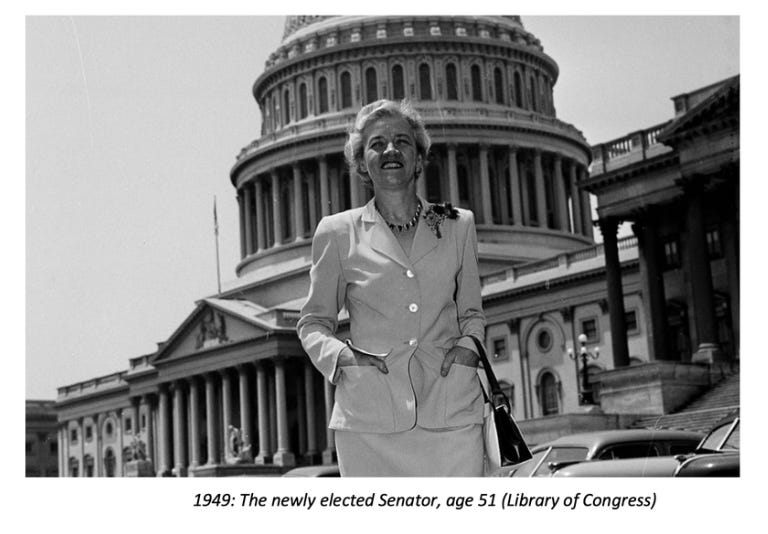
In 1950, Smith joined the Air Force Reserves as a Lieutenant. Her eventual Senate seniority put her on powerful committees: Appropriations, Armed Services and Government Operations, which she traded for the Aeronautical and Space Sciences Committee in 1959. A hawk on foreign affairs, she became an expert on national security.
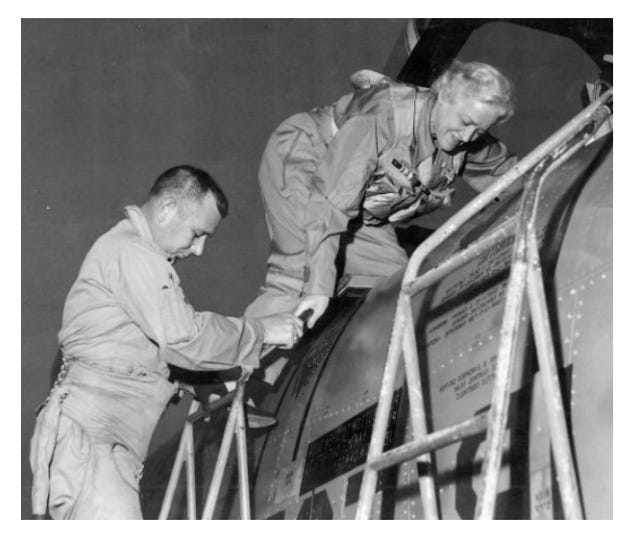
1957: “Mach Buster Maggie: The Supersonic Senator from Maine” breaks sound barrier; note her high heels.
She ran for president in 1964, “with few illusions and no money.” Smith lost every primary but was the first woman to have her name advanced for nomination for the presidency by a major party. She refused to release her twenty-seven delegates, so the nomination of conservative Arizona Senator Barry Goldwater was not unanimous.
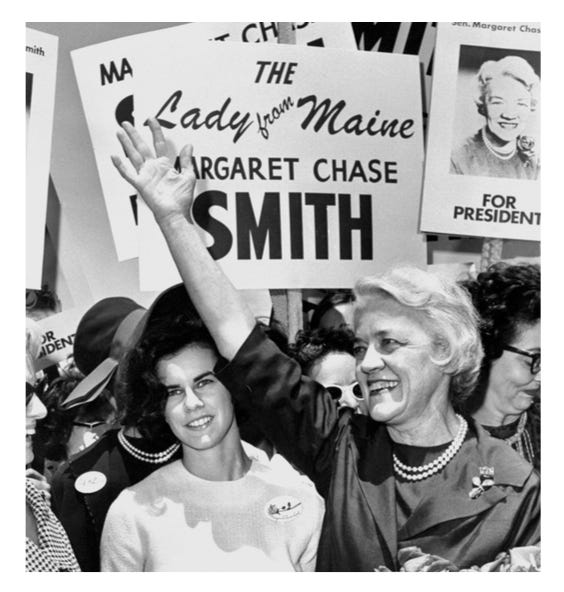
1964: Campaigning for president, age 66
With a red rose in her lapel, Smith was a Senate institution. Between June 1955 and September 1968, when she broke her hip, she cast 2,941 consecutive votes. Smith remained a party maverick, supporting the Great Society and civil rights and voting against President Nixon’s Supreme Court nominees, Clement Haynsworth and Harrold Carswell.
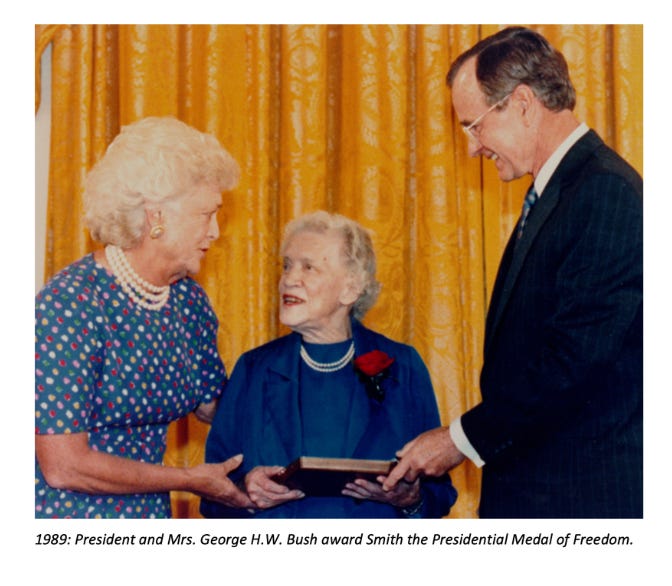
Known as “the conscience of the Senate,” Smith died in 1995 at age 97, at home in Skowhegan. Margret Chase Smith remains a model of courage and integrity. As she ended her 1950 speech, “It is high time that we stopped thinking politically as Republicans and Democrats, about elections, and started thinking patriotically as Americans.”
How many incumbents in today’s Congress have had the courage to act with her integrity?
SOURCES:
Unless otherwise identified, photographs are the public domain.
Margaret Chase Smith, “Declaration of Conscience,” https://www.senate.gov/artandhistory/history/resources/pdf/SmithDeclaration.pdf
Committee on House Administration of the US House of Representatives, Women in Congress, 1917-2006 (US Government Printing Office, 2006).
Peggy Noonan, “Who’ll Be 2020’s Margaret Chase Smith?” Wall Street Journal (December 5-6, 2020), https://www.wsj.com/articles/wholl-be-2020s-margaret-chase-smith-11607040752
“Joseph McCarthy,” https://www.history.com/topics/cold-war/joseph-mccarthy
“Have You No Sense of Decency?” https://www.senate.gov/about/powers-procedures/investigations/mccarthy-hearings/have-you-no-sense-of-decency.htm
Karen and Herbert N. Foerestal, Climbing the Hill: Gender Conflict in Congress (Praeger, 1996).
Janann Sherman, No Place for a Woman: A Life of Senator Margaret Chase Smith (Rutgers, 2000).
Richard Severo, “Margaret Chase Smith Is Dead at 97; Maine Republican Made History Twice,” New York Times (May 30, 1995),
Statistics: The Center for Women in Politics: www.cawp.rutgers.edu/facts
“Mach Buster Maggie: The Supersonic Senator from Maine,” https://www.senate.gov/artandhistory/history/minute/Mach_Buster_Maggie.htm
Elisabeth Griffith, FORMIDABLE: American Women and the Fight for Equality, 1920-2020 (Pegasus, 2022).
I read your newsletter and Heather Cox Richardson. Smith was lucky in her backgound. Many women think they don't have the right to have rights.