

LOOSE ENDS, 3.18.2026

Dear Readers: Thanks as always for your cheers, corrections, chastisements and comments.
One reader offered a belated critique of my essay about the 1924 IMMIGRATION ACT, posted in May 2024: “Chattel slaves were not ‘involuntary immigrants.’ The use of the word “immigrants” to describe chattel is being done to erase the Trans-Atlantic slave trade and chattel slavery. Founding documents, such as the 1783 Treaty of Paris, do not use the word ‘immigrants’ to refer to chattel slaves. The Treaty accurately refers to chattel slaves as ‘property.’” The writer is correct.
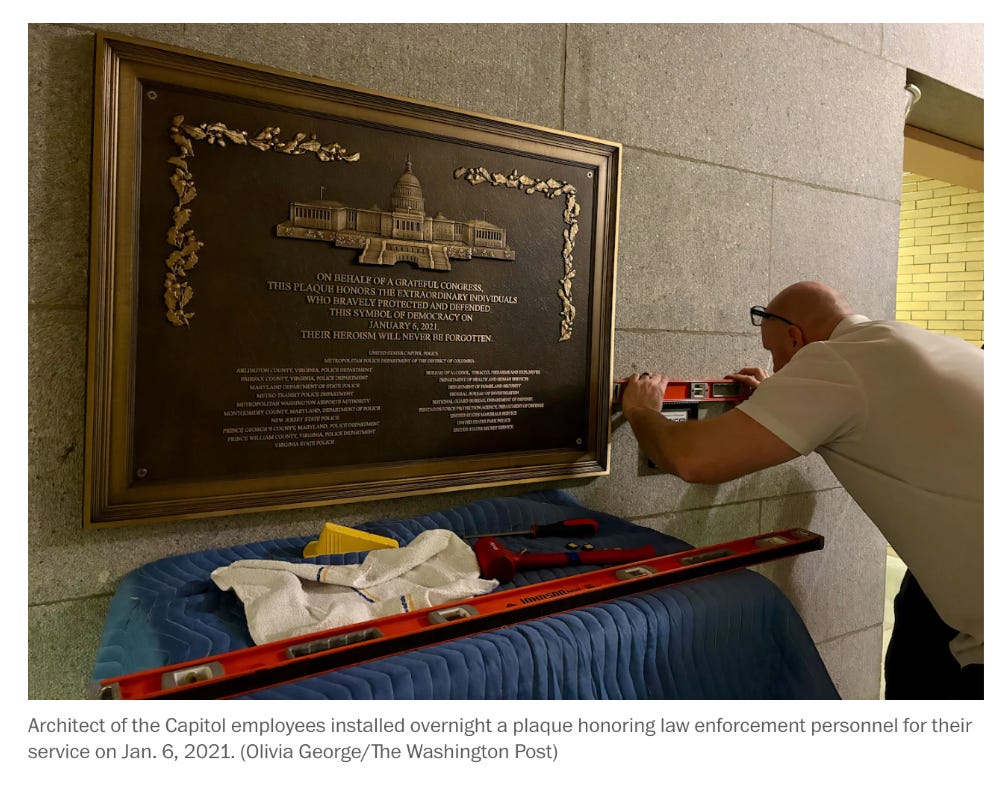
EVIDENCE & ERASURE (1.6) noted the anniversary of the January 6, 2021, insurrection. “To honor the women and men who saved the lives of those inside the building and to ensure that the history of this attack on the Capitol – and on democracy – is not forgotten,” the Congress
called for a commemorative plaque to be installed on the West Front of the building by 2023. It was created but remained in the basement.
When House Speaker Mike Johnson (R-LA) refused to authorize the Architect of the Capitol to install it, Democrats mounted copies outside their offices. In January, the Senate passed a resolution by unanimous consent, without objection or a recorded vote, ordering display of the plaque on the Senate side of the Capitol. It was proposed by Senators Jeff Merkley (D-OR) and Thom Tillis (R-NC).
Before dawn on Saturday, March 7, two workers installed the plaque inside the building on the Senate side. There was no ceremony.
The plaque reads: “On behalf of a grateful Congress, this plaque honors the extraordinary individuals who bravely protected and defended this symbol of democracy on January 6, 2021. Their heroism will never be forgotten.” Next to it is a QR code linked to “Honored Law Enforcement.” The list is forty-five pages long. Two law enforcement officers have sued to have it placed, as ordered, outside on the West Front.
President Trump’s orders to scrub historic sites and museums of “partisan ideology” and descriptions that “disparage” the nation’s past must be a challenge to enact. Without descriptions of the 1957 murder of Emmett Till, does the Mississippi Emmett Till and Mamie Till-Mobley National Monument have a purpose? Or West Virginia’s Harpers Ferry National Historical Park, the site of John Brown’s raid in 1859, without information about slavery and abolition?
Even items for sale in National Park Service bookstores have been submitted for review, including “WELL BEHAVED WOMEN RARELY MAKE HISTORY” bumper stickers, at the Belmont-Paul Women’s Equality National Monument in Washington, DC.
The Department of Interior has created a confidential database of signage and items that been flagged for revision or removal. It was leaked by “civil servants on the front lines” to show how the government is trying to “erase history and undermine science.” Some sites responded, “Nothing to report.”
President Trump marked the centennial of Carter Woodson’s call for BLACK HISTORY MONTH (2.5) with a reception at the White House at which he asserted that civil rights and racial equality have been achieved. He was cheered by an audience of Black Republicans and other supporters.
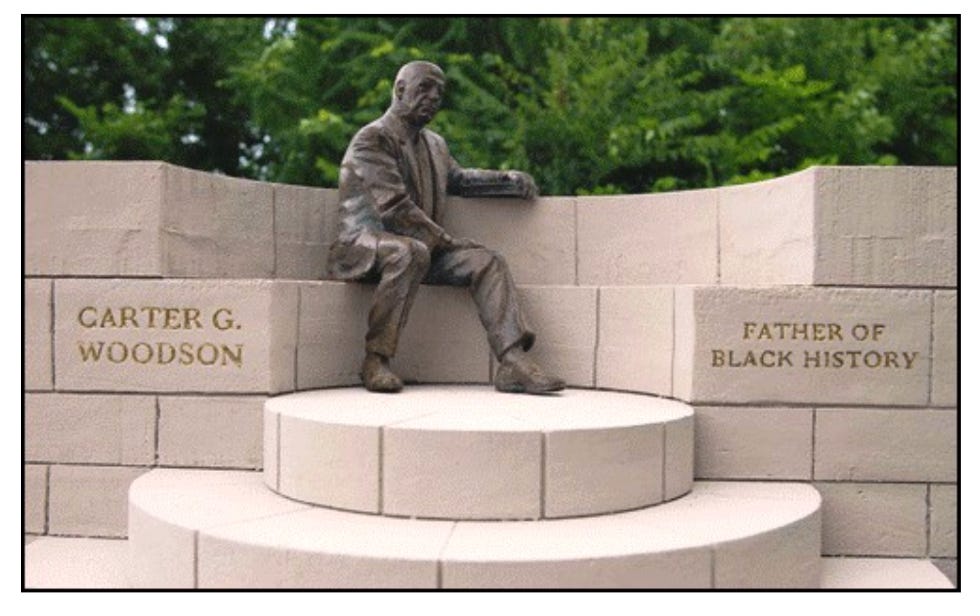
A DC resident reminded me, that in addition to Woodson’s home, a National Historic Site in WDC, there is statue on the corner of Ninth Street and Rhode Island Avenue, NW. Dedicated in 2016, the Woodson Memorial depicts the historian seated. The back of the circular memorial includes a shelf of bronze books written by “the Father of Black History.”
My essay linking LINCOLN’S BIRTHDAY (2.12) to the founding of the NAACP had lots of fans, including one who loves sports: “Another home run – or a 10, to use Olympic scoring.” A fan of Jane Addams, who established Hull House, reminded me that she was a founder of the NAACP and the ACLU.
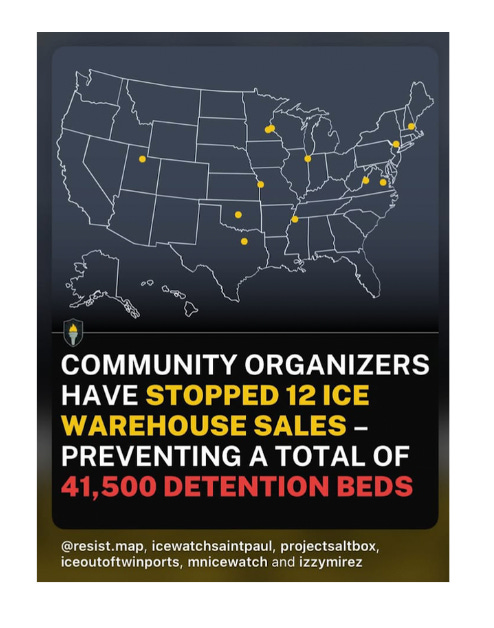
INTERNMENT (REPRISED) (2.19) provoked several comments about detention centers. Americans want immigrants convicted of felonies deported, but they do not all support how ICE has carried out that mandate. Many are disconcerted by plans to establish detention centers and processing sites in every state. There’s been “Not In My Back Yard” pushback. Communities are torn between the economic benefits of new jobs versus the strain on community infrastructure.
It occurred to me, after writing that the US first used internment camps in the Philippines during the Spanish American War, that confining Native Americans to reservations was another form of detainment.
The President’s Proclamation of WOMEN’S HISTORY MONTH (3.10) provoked some feisty feedback. A reader in New Jersey forwarded a compilation of news clips featuring the President describing and denigrating the “nasty women” who have challenged him, ending with “Quiet Piggy.”
Another reader was initially annoyed that the Ford Motor Company touted a MEN’S ONLY Ford Explorer on International Women’s Day. It turned out to be a clever tribute to the contributions women had made to automobile design, including car heaters, brake lights, turn signals, windshield wipers, rearview mirrors and GPS systems. A car designed by “men only” would lack those innovations.
Since they were invented, cars have been symbols of masculinity. In WOMEN AT THE WHEEL: A CENTURY OF BUYING, DRIVING AND FIXING CARS (2017), Katherine Parkin describes the impact of cars on sexual dynamics. In the early 1900s, many men were uncomfortable with the idea that cars allowed women to leave home. That potential outcome contributed to the myth that women were bad drivers, did not understand mechanics and should be relegated to the passenger seat. American suffragists purposely campaigned in cars, to demonstrate their equality. Eleanor Roosevelt driving across New York state in the 1920s or Nancy Drew chasing crooks in her blue roadster in the 1930s also symbolized female independence.
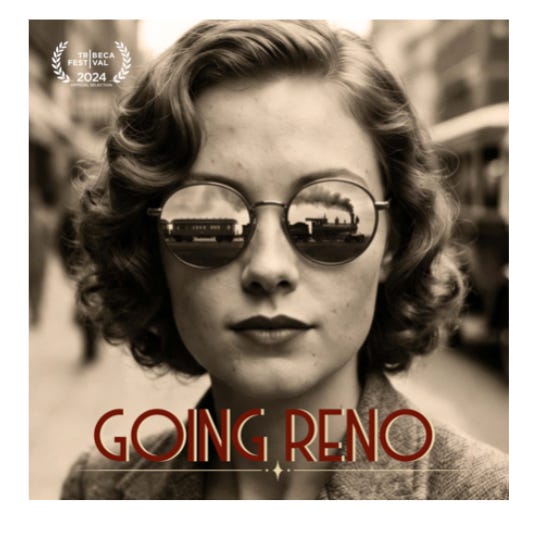
More disruptive than driving was divorce. Premiering this week is the podcast series, GOING RENO, about the “quickie” six-week divorce industry in Nevada in the 1930s.
I appreciated a comment from a New Yorker, who valued “this comprehensive listing of important women in American history.” Too many of those notable women remain “hidden figures,” like the automobile engineers. Or Jo Ann Bland, who died in February. In March 1965, at age eleven, she was the youngest participant in the Bloody Sunday March across the Edmund Pettus Bridge in Selma, Alabama. The bravery of those civil rights activists, attacked by state troopers and Klan members, propelled passage of the 1965 Voting Rights Act. Which has been gutted by the Supreme Court and state legislatures and is now threatened by the SAVE Act.
The night of the State of the Union Address, Democratic women in attendance wore “suffrage white” to signal their opposition to the “Safeguard American Voter Eligibility” Act because it undermines states’ right to determine voter eligibility, puts burdens on citizens to produce documents they may not have, complicates the rights of women who have changed the names following marriage or divorce, and limits mail-in voting.
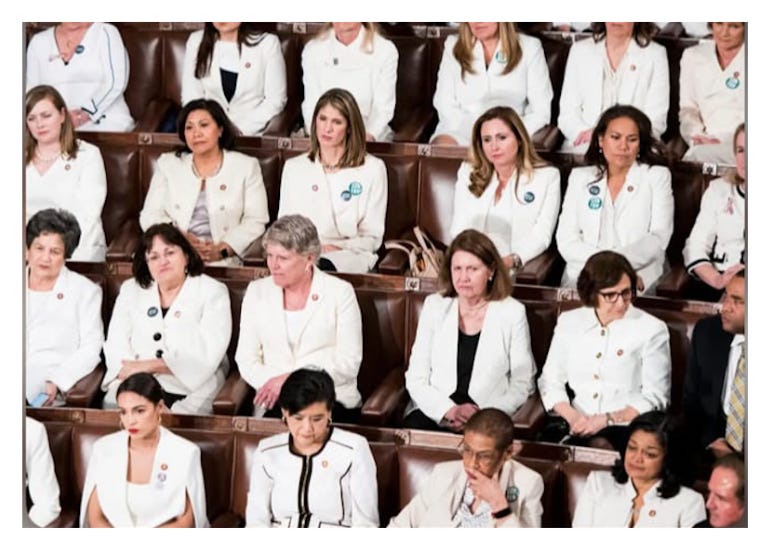
Despite its initial defeat in the Senate, the President has increased pressure on that body, insisting that it change the filibuster rule and add more language denying medical care to trans young people. Mr. Trump has threatened that he would sign no other legislation until the SAVE Act passed.
Yesterday the Senate voted 51-48 to reopen debate. Majority Leader John Thune (R-ND) has pledged to allow debate and schedule another vote but he does not guarantee the 60 votes needed for passage.
To revisit past PINKS about notable women, search pinkthreads@substack.com for an achive for past essays -- about Alice Paul (7.9.25), Anita Hill (10.12.24), Barbie (3.9.24), Betty Friedan (2.19.25), Billy Holiday (4.21.25), Constance Baker Motley (5.17.25), Dolores Huerta (4.9.25), Eleanor Roosevelt (10.11.24), Elizabeth Cady Stanton (11.12.25), the ERA, Frances Perkins (3.4.25), Gloria Steinem (3.25.25), Jane Addams (9.5.24), Jeannette Rankin (4.2.25), Lilly Ledbetter (2.29.26), Marian Anderson (4.9.25), Margaret Chase Smith (5.30.24), Margaret Sanger (5.12.24), Mary Church Terrell (9.23.25), Nancy Drew (4.24.25), Rosa Parks (12.2.24), Ruby Bridges (11.14.24), Rosie the Riveter (3.21.25), Sally Ride (6.16.25), Susan B. Anthony (2.15.25) – as well as athletes. witches, midwives, Supreme Court justices, veterans, office holders and so many more change agents!
Regular readers will have noticed that I only solicit subscriptions in LOOSE ENDS rather than in PINKS, mostly because I think the blurbs interrupt the conversation and disrupt the text. But I hope you will continue to share these with friends and upgrade to a paid subscription as your resources allow. Thank you.
Onward!
This is a wonderful piece!!
Love reading these pieces and learning more about our imperfect union and the work that's been done--and that we need to continue--to truly make our country great.