LOOSE ENDS, 4.7.26

My OPENING DAY (3.26) Pink began as a LOOSE ENDS post, with a brief mention of the new Women’s Professional Baseball League. But the story of women in baseball pulled me in. That PINK became my most popular essay this year, with more readers than subscribers. Thank you for sharing it. I heard from fans in Baltimore, MD, and Middlebury, VT. A journalist in LA read it to her daughter: “She is still sticking it out in baseball with her friends. The season starts next week and we lobbied to keep the four girls in the league on the same team (as they requested) for the love of the game.”
A neighbor booked a trip to Cooperstown, adding, “I loved ‘A League of Their Own’ and Tom Hanks’ response to Geena Davis when she was ready to quit because baseball just was so hard. ‘Of course it’s hard. The hard is what makes baseball great. If it wasn’t hard, everyone would do it.’ It always stuck with me when what I was doing was ‘too hard.’ I thought about that quote and how fortunate I was to do a hard thing.”
Another reader connected Cracker Jacks (and Jills) to the back story about “Take Me Out to the Ball Game,” which has been belted out during the seventh inning stretch since Chicago Cubs announcer Harry Caray started the tradition fifty years ago. According to the Library of Congress, the baseball ditty’s chorus is among the three most recognized songs in the US, after our national anthem and “Happy Birthday.”
Take me out to the ball game,
Take me out with the crowd.
Buy me some peanuts and cracker jack,
I don’t care if I never get back,
Let me root, root, root for the home team,
If they don’t win it’s a shame.
For it’s one, two, three strikes, you’re out,
At the old ball game.
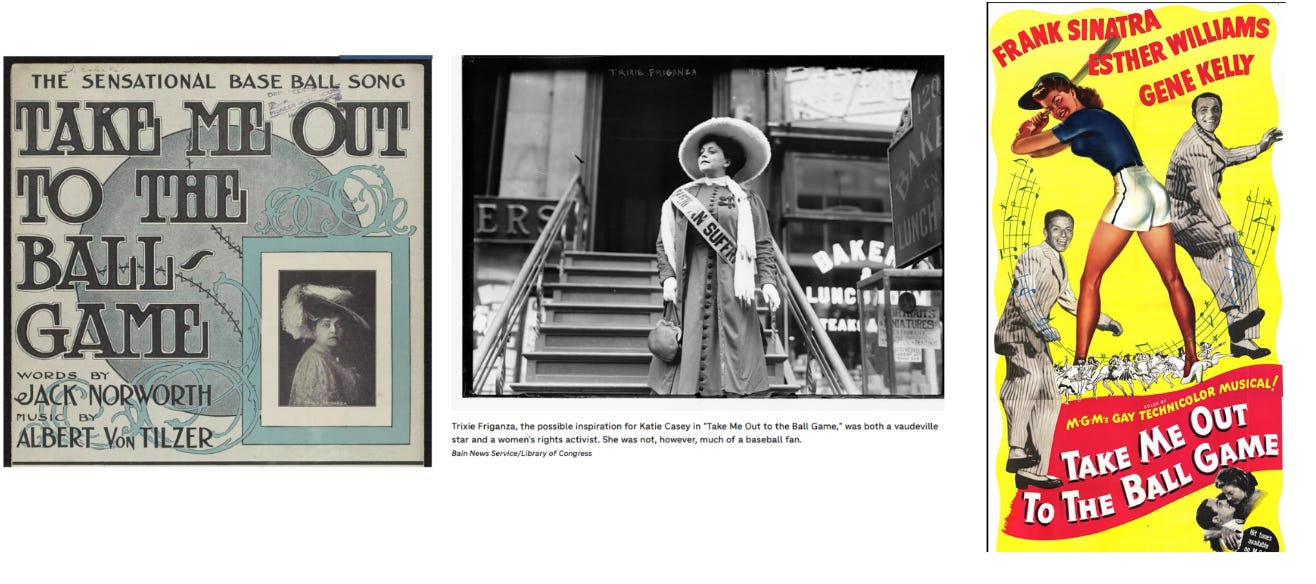
Written in fifteen minutes in 1908, by composer Albert von Tilzer and lyricist Jack Norworth, it was an instant hit on the vaudeville stage. The waltz was inspired by an epic season, to capitalize on baseball’s growing popularity. The long-forgotten original lyrics celebrate a woman who loves baseball.
Katie Casey saw all the games,
Knew the players by their first names;
Told the umpire he was wrong,
All along good and strong.
When the score was just two to two,
Katie Casey knew what to do,
Just to cheer up the boys she knew,
She made the gang sing this song: [chorus]
Long before women could vote, they were playing baseball at women’s colleges and in women’s leagues like the 1890s Boston Bloomers. A Black women’s team, the Dolly Vardens, formed in Philadelphia in 1867. Women filled the stands on “Ladies Days.”
George Boziwick, author of THE MUSIC OF BASEBALL, speculates that Katie Casey (possibly a reference to “Casey at the Bat” from 1888) was inspired by Trixie Friganza, a vaudeville star and suffragist, who was having an affair with the lyricist. Her picture appears on some of the sheet music.
One wonders what happened to their romance. In 1927, Norworth rewrote the lyrics, changing Katie Casey to Nelly Kelly, who “frets and pouts.” Nelly’s name was immortalized in the title song in a 1949 Busby Berkeley. Frank Sinatra and Gene Kelly star as players who moonlight as vaudeville performers.
In response to TRIANGLE (3.25), author Elizabeth Winthrop wrote: “A remarkable history... I was inspired by reading about the Triangle Shirtwaist Fire to look at the photographs by Lewis Hine on child labor in the textile factories, which resulted in my novel, COUNTING ON GRACE...I love that you are looking at the history of women and cotton throughout the ages.”
“Deadlier Than Gettysburg,” a book review in The Atlantic (March 2026), prompts me to update INTERNMENT (2.19). The first time the US used internment was not in the Philippines, during the Spanish-American War, but during the Civil War. In A Fate Worse Than Hell, W. Fitzhugh Brundage documents the inhumane treatment of prisoners then.
Previous practice had called for prisoner exchanges. The North resisted because it would acknowledge Confederate nationhood. After the Emancipation Proclamation, the South refused to exchange Black soldiers. Caging captured combatants was the alternative. While 29% of Andersonville’s prisoners died (three times more than at Gettysburg), so did 25% of those held at Elmira, NY.
The atrocities prompted the War Department to issue General War Orders No. 100 in 1863, under which the Confederate commander of Andersonville would be convicted and executed. “Military necessity does not admit of cruelty.” Another timely lesson.
One of the outcomes of the LILLY LEDBETTER EQUAL PAY ACT (1.30) was an initiative that the Equal Employment Opportunity Commission require employers to submit pay data broken down by sex, ethnicity and race. The first Trump administration ended that practice, because it burdened employers. The Census Bureau and the Department of Labor are still documenting.
Based on 2024 data, the gender pay gap has widened for the second year in a row, for the first time since 1971. According to the Census Bureau, women working full-time, year-round, earn 81 cents for every dollar men earn, down from 83 cents in 2023 and 84 cents in 2022.
Equal Pay Day draws attention to pay disparities between men and women. It marks how far into a new calendar year women must work to make what men earned the year before. This year it was March 26. For LGBTQ+ women, it will be April 17; for Black women, July 21; for moms, August 6; for Latinas, October 8; for disabled women, October 20.
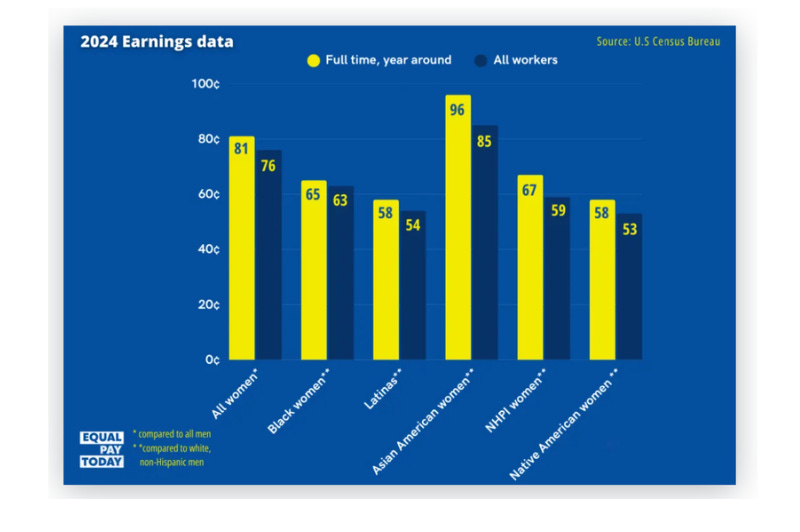
One explanation is that men’s median income grew by 3.7%, while women’s remained stagnant. Another is occupational segregation, with women doing more low-wage work as hotel housekeepers, waitresses and day-care workers.
According to the Department of Labor, the US workforce is employing more women than men, for only the third time ever. Traditionally male-dominated jobs, like manufacturing and construction, are shrinking, while lower-paid female jobs, like health care, are increasing. Many men are reluctant to do “women’s work,” even in the job market’s fastest-growing sector.
ERASURE & EVIDENCE (1.6), the title of my essay about the January 6 insurrection, might be the thesis of every PINK THREAD. The list of law enforcement officers who bravely defended the Capitol that day, honored by a plaque the Senate acted independently to install on its side of the Capitol, omits sixteen names, including some who were most viciously attacked.
Meanwhile, three insurrectionists pardoned by President Trump are running for office. David Medina, charged with obstructing an official proceeding, is running for governor of Oregon. Tyler Dykes, convicted of assaulting a law enforcement officer, is running for Congress from South Carolina. Adam Johnson, who was filmed carrying Nancy Pelosi’s lectern through the Capitol Rotunda and was convicted of trespassing, is running for local office in Manatee County, Florida.
The President is also attempting to revise the architecture of the White House, the National Mall and the city of Washington, so carefully created over decades by Pierre L’Enfant, James Hoban, Benjamin Latrobe, Frederick Law Olmsted and the members of the 1902 McMillan Commission, all of whom contributed to the “monumental core” of Washington.
Philip Kennicott, the Washington Post’s Pulitzer Prize-winning arts and architecture critic, lists the changes the President is imposing on Washington: gilding the Oval Office; paving the Rose Garden; demolishing the East Wing; proposing a ballroom, triumphal arch, sculpture park; renovating the Kennedy Center; mounting controversial statues; and hanging banners bearing his image on public buildings.
Kennicott’s assessment, “Trump’s Tortuous Designs,” cites Latrobe. “A graceful and refined simplicity is the highest achievement of taste and art,” wrote America’s first great architect. “We find ornaments increase in proportion as art declines, or as ignorance abounds.”
In contrast, an IN PURSUIT essay on John Quincy Adams, noted his additions additions to the White House: planting saplings representing key moments in American history, including an acorn from Boston’s Tree of Liberty, around which the Sons of Liberty met, and seeds from an oak tree in Baltimore that bore scars from cannon fired during the War of 1812.
Thank you for your continued enthusiasm for PINK THREADS. Your support allows me to keep producing snippets of American women’s history. I believe strongly that learning more about American history and civics will help us safeguard our democratic republic.
Onward! Happy spring!
Betsy