

LOOSE ENDS, 7.11.2026

Dear Readers: I may have made an etymological error, by calling these collections of your comments LOOSE ENDS. It did not occur to me until today to check the meaning of the phrase. Webster’s defines it as “unfinished business, something left hanging loose,” which does apply to these additional details, but the term originated on ships, not in sewing rooms. It referred to the unsecured ends of ropes, which could cause accidents.
The domestic term, more closely related to threads and stitching as a metaphor for the piecework quilt of women’s history, should have been LOOSE THREADS. I did once title the embarrassing second correction of an error LOOSING THE THREAD.
The definition of “loose ends” (almost always plural) as “unresolved details or incomplete aspects of a story” does apply, so I’ll keep it. It’s too late to substitute “snippets.”
Curiously, PINK readers not only comment on my essays but also on LOOSE ENDS. The latest (6.21) provoked yet another spelling correction: beetles (obviously!) not beatles (my error) in referring to Dutch elm disease, which followed up on an earlier spelling mistake, chestnut (tree) instead of Chesnut (Confederate diarist). Despite being a careless speller, I’m a huge fan of spelling bees, a future topic.
That LOOSE END mentioned the MOMA retrospective of western films, which prompted a moment of nostalgia. “On weekly Saturday afternoons, my brothers and I used to walk a mile each way in our small town to the movie theatre where we each paid a quarter from our $1.00 allowances to watch the latest flick of Roy Rogers, Hopalong Cassidy, or Gene Autry. I was terrified when ominous music indicated the Indians were coming over a hill so went to the refreshment stand to get a coke or popcorn. How incredibly simple life was in the 50’s!!!”
A reader who is now a Maine resident sent this recollection of MARGARET CHASE SMITH (6.1):
“Betsy, I loved your piece on Margaret Chase Smith. As part of the Vassar Wellesley Washington Internship program in 1960 I remember encountering her several times in the corridors of the Senate Office Building. She always had a rose in her lapel and a smile along with a greeting. Years later we visited the people who had purchased the home she had in Cundys Harbor, down the road from us.”
I was moved by this response to the essay on LGBTQ AMERICANS (6.27): “Thank you always – but especially today – for Pink Threads. What a cogent, powerful column. Shows the breadth of your historical skills and heart. Boffo work. Huge hugs Dr. Griffith. Thank you. Ever onward.”
I had forgotten until I wrote about WONDER WOMAN (7.1) that among the symbols of women’s work, held by the eight-armed Hindu goddess on the cover of the trial issue of MS, was a typewriter. Related to the use of “Ms.”, a reader in upstate New York wrote:
“On October 6, 1977, the New York Times featured a story about my business with a picture of my partner and me on the front page of the business section. I was 8 months pregnant and reluctant to be titled Miss B------. I argued that I was not Mrs. B------ and although married, I was not known professionally as Mrs. S----. I opted for Ms. B------. They agreed. The early edition of the Times titled me Ms. B------. In the later edition, they eliminated my title and called me Kathleen B------.”
Related to Wonder Woman, from a fellow out west: “I once had dinner with Wonder Woman. While I was on the board of our local hospital, I became friends with a fellow board member, an actor on a television series. He arranged for Lynda Carter, who played Wonder Woman in the TV series, to attend our annual fundraiser. I had the good fortune to be seated with her. That’s as close to Hollywood as I’ve ever gotten!!”
Two more: “I’ve considered Gloria Steinem an inspiration. My mother and I had many, many conversations about her throughout the 70-80s. Dad, not so much!” “Great article on both Wonder Woman and Steinem, both feminist icons to me.”
Readers enjoyed the soundtrack for TYPEWRITERS (6.28). A musically informed reader added The Typewriter by Leroy Anderson to my play list. Mention of Dolly Parton cued heart emojis. Many readers remembered when female college graduates were seen by employers as qualified only to type. Wrote a college educated, female business owner: “Something I’m grateful I never managed to learn! My grandfather used to say, ‘Push pens, but never brooms.’ He certainly did not mean type for someone else.”
Another had a different view: “The summer before college, I bought a book to help me learn to type. I sat in my brothers’ bedroom at a desk with my father‘s Olivetti. I was so glad I did. ‘Nimble fingers’ but some initiative.” My first lessons in art history came from typing my roommate’s papers. Now everyone learns to “type” on a QWERTY keyboard, and few people know cursive.
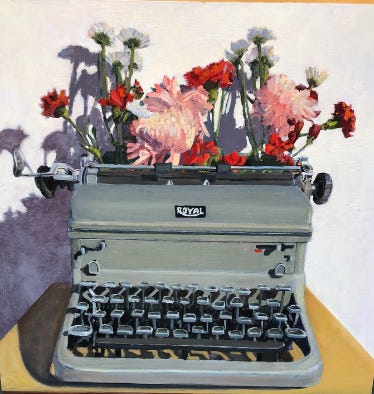
A local reader introduced me to the work of painter Brian Fenci called Typewriter (Strange Vase #10):
I keep learning more about AMERICA’S BIRTHDAY PARTIES (7.4), so I will likely revise and reprise that essay next year. For now, some additions:
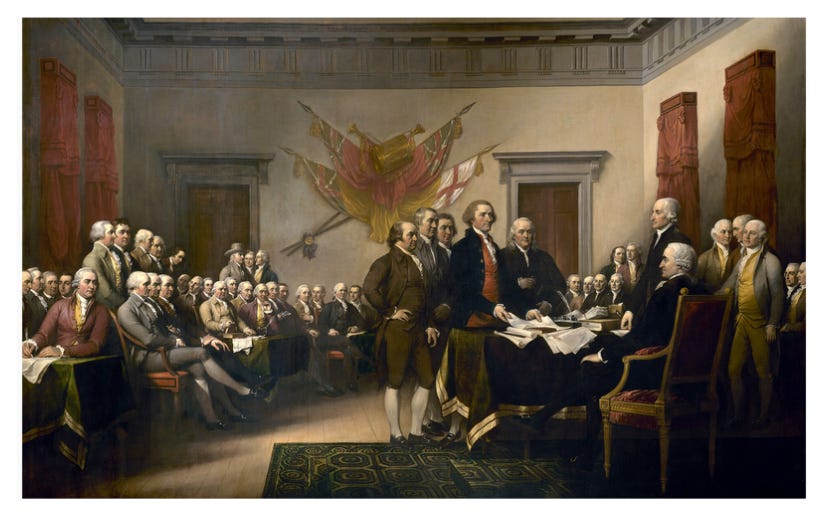
The common but incorrect conviction that all fifty-six members of the Second Continental Congress signed the Declaration of Independence on July 4, 1776, is based on a painting that has hung in the United States Capitol Rotunda since 1826. “The Declaration of Independence,” a 12’ x 18’ oil painting by John Trumbull, depicts the June 28 introduction of the Declaration by the five members of its drafting committee. It was a government publication. “Art of the Capitol,” that identified the forty-seven figures included as signers.
The Declaration printed on July 4 had no signatures. After they were collected on August 2, a second printing listed typeset names for the first time, providing the British with a list of traitors. That version, the Goddard Broadside, was commissioned by Congress in 1777. It was produced by Mary Katharine Goddard, an experienced printer in Baltimore. She had printed Thomas Paine’s Common Sense, published the Maryland Journal, served as the city’s postmaster and owned a bookstore.
Goddard added her name to the bottom of the document: “Baltimore, in Maryland: Printed by Mary Katharine Goddard.” She came from a family of printers. When her younger brother started another newspaper in Philadelphia, Goddard ran the Baltimore operation from 1774-1784, when he forced her out.
She was replaced as postmaster by the Postmaster General, after fourteen years, because the job entailed “more traveling ... than a woman could undertake.” A petition signed by 238 community leaders failed to reverse the decision. When she died in 1816, at 78, she freed her female slave and left her all her property.
As I reported, Daniel Webster spoke in July 1851. In an era of increasing regional tension over the extension of slavery, Webster noted that President Andrew Jackson had proposed a bridge “with arches,” linking the District to Virginia, as a symbol of the union of North and South. No design related to bridges of memorials has included an arch, but the Trump administration has seized on those words to justify his triumphal arch.
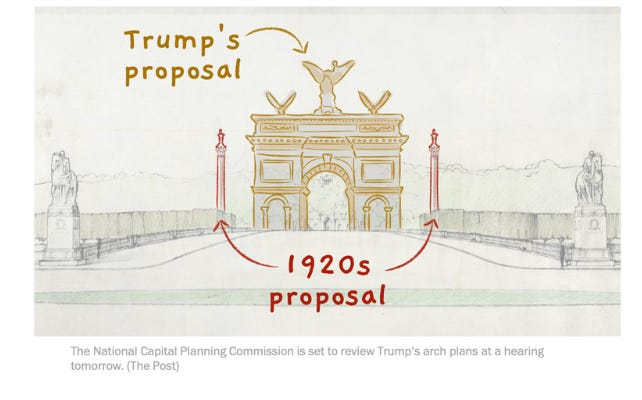
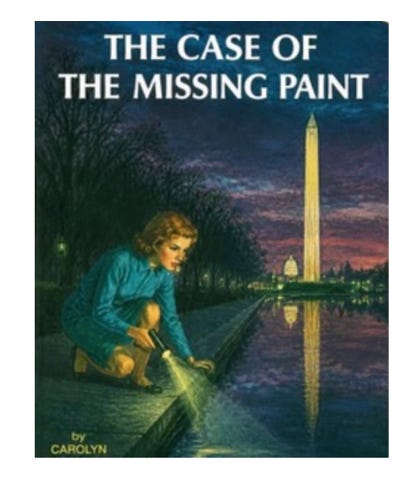
On the topic of Trump’s vandalism of our beautiful city’s iconic landmarks, a reader forwarded this Instagram post, related to an early PINK about NANCY DREW (4.28.24).
For an excellent, engaging conversation about the Declaration, I recommend this program at the National Constitution Center, “The American Idea at 250.” It features historian Jon Meacham, former US Archivist Colleen Shogan and Harvard professor Danielle Allen.
Finally, a note about the color pink and my PINK THREADS logo. Thanks to my fifteen-year-old grandson, I’m obsessed with the World Cup. Not only the competition but the stories about the groundskeepers and the height of the grass; about the Abilene, Kansas, high school band learning the Algerian national anthem to welcome players; the delight international visitors have found in free refills, wide aisles, air-conditioning, ranch dressing and the warm welcome of everyday Americans. I do not understand “offsides,” but my vocabulary now includes match, pitch, kit and boots. And PINK cleats! Nike, Adidas, Puma, New Balance and other brands independently released footwear with pink parts. They chose the color for its visibility and research indicating that bright colors are energizing. Pink is viewed as powerful. Exactly.
Thanks for being loyal and enthusiastic readers. Please encourage others to subscribe and/or upgrade to paid.
Ever onward!
Betsy
Wonder Woman (Lynda Carter) was a young 17/18 year old singer in club in Phoenix. I did happen to see her perform and then attend a small gathering of folks later. She has been a fine actress. Books of interest: The Secret History of Wonder Woman by Jill Lepore; The Lazy B- by Sandra Day Oconner and Alan Day (Brother and Sister). A book of growing up on an Arizona Ranch and some challenges facing her through her life. I had the opportunity to hear her speak on one luncheon meeting. There are many women who have outstanding contributions to this country. It is nice to profile and hear about them.
I don't mioind little errors. Again I detest Wonder Woman. Gloria Steinem looks the way she still does because she was born with those genes. Nothing to admire.