

LOOSE ENDS: 8.5.26

Please excuse a brief pause in posts. Your author has been distracted by caring for my adorable grand girl, who couldn’t go to daycare because she had a temperature, and by a still busted freezer compressor. I had planned to report on the infamous 1974 ordination of the Philadelphia Eleven, supposedly renegade female Episcopal priests. Ah well. Next year . . . Thank you for your patience.
READER RESPONSES remain my reward for writing these snippets.
· In an observation about Manifest Destiny, the theme of FRONTIER WOMEN (5.4), a western reader reported an observation by Rick Atkinson, the Pulitzer Prize-winning military historian currently working on the third volume of his American Revolutionary War narrative. Atkinson asserted that the Founders intended to conquer the west, because they called themselves the Continental Congress, created the Continental Army and issued Continental currency.
· A history buff corrected my essay about the origins of MEMORIAL DAY (5.30). I stated incorrectly that it was celebrated on the third Monday in May. He knew that the 1968 Uniform Monday Holiday Act set it on the last Monday in May, so it falls between May 25 and 31.
· About SENECA FALLS (7.19), a retired foreign service officer “was thoroughly captivated by your expanded account of the Seneca Falls ladies (and their male supporters) and the abysmal lack of rights that preceded it. To think of Lucretia Mott not being given entry to the English abolitionists convention! A bookend to the current MAGA effort to shut down our democracy with the SAVE Act. Each week I call my electeds on that and other outrages.”
· He also responded to a recent LOOSE ENDS (7.11): “However you call them, please keep up with your Loose Ends, which are every bit as lively as the main articles!” A Wellesley classmate was equally encouraging: “Don’t know how w/everything else you have going on, you manage to keep Loose whatever going, but it is always interesting and fun.” Her comment refers to whether the expression “loose ends” related to threads, lines or ropes. An athlete, she added this etymological factoid. In baseball, a frozen rope is a “hard-hit line drive,” whereas “on a rope” is a broadcaster term for “a perfect, flat throw from an outfielder to a base.”
I recently heard Virginia Evans, author of The Correspondent, describe her “writing process.” She thinks of every character as a strand of beads, hanging from a doorway in fraternity house. (Truly.) Her task is to braid them all together into a thick rope. If one thread comes loose, or a character is no longer relevant, she goes back and cuts it out.
IN THE NEWS, reports of three deaths caught my attention.
· I first learned about Wally Funk (1939-2026), a pilot and aspiring astronaut, when I wrote about Sally Ride in FORMIDABLE (and a subsequent PINK). After President Kennedy called for exploring the new frontier of space, in 1961, the government enlisted military test pilots in the first corps of astronauts. At the time, thirteen female pilots had qualified independently. The youngest was Wally Funk. She never flew for NASA. In 2021, at age 82, she accompanied Amazon’s Jeff Bezos on a 10-minute, 19- second, Blue Origin space flight.
· In 1971, Ida Schmertz (1935-2026) co-founded the Center for American Women and Politics (CAWP) at Rutgers University with English professor Ruth Mandel. Before then, no one had systematically measured women’s political engagement as candidates and officeholders. It would be another decade before anyone paid attention to female voting patterns. Having assumed for six decades that women voted like their husbands, pollsters were startled to discover a “gender gap.”
Schmertz, who described herself as “a feminist before I knew the word,” left CAWP to advise NY Governor Hugh Carey. There she succeeded in efforts to hire the first female dock workers. She joined American Express in 1979, becoming its first female senior vice president. I knew Ida and Ruth when I worked with the National Women’s Political Caucus in the early 1970s.
PINK readers will know how often I cite CAWP statistics about numbers of women, for example, in the US Senate in 1926 (zero) or 2026 (27, the highest number to date).
· The death of Republican Senator Lindsey Graham resulted in that 27th senator, when the governor of South Carolina appointed Graham’s sister, Darline Nordone, to fill his seat. Women filling seats created by the death of husbands or fathers, known as “widow’s succession,” was the way most women reached Congress until the 2001.
In the decade after passage of the Nineteenth Amendment, one woman was appointed to the Senate, for 24-hours (Rebecca Felton, D-GA), and eleven served in the House, eight Republicans and three Democrats. All were white. Four were widows and two were daughters of politicians. Ruth Hanna McCormick (R-IL) was both. She left the House to run for Senate in 1930, winning the primary but losing the general.
Five women served only one term. Widow Florence Kahn (D-CA), the first Jewish woman to serve and the first woman appointed to the Appropriations Committee, stayed twelve years, until losing to a New Deal Democrat. Edith Nourse Rogers (R-MA) and Mary Norton (D-NJ), the first Catholic woman, were the only members of that first class in Congress to serve terms into the 1950s, accruing seniority and authority.
In date, 48 women, 8 senators and 40 representatives, have succeeded a family member. Graham Nordone is competing in the August 11, hotly contested primary, to run for a full Senate term. Were she to win, she will face Democrat Annie Andrews, a pediatrician. Several other female challengers and incumbents are competing for Senate seats. We can rely on CAWP to update the final tally in January 2027.
RECURRING THEMES
It is hard for historians not to take President Trump’s ATTACK ON HISTORY, evidence and facts personally. The latest assault was a report, issued on July 4 by the White House Domestic Policy Council, “Saving America’s Story: How Ideological Capture at the Smithsonian Institution’s Museum of American History Erases Our Heritage.” It accuses the museum of “anti-white activism,” having traded “settled truth and basic history of political activism and division.”
ARGH.
History is not settled. It depends on evidence, documents, data. Uncovering new facts, examining past conclusions from new perspectives, questioning bias, tolerating ambiguity and admitting the complexity of our past are all part of the job. American history is not always uplifting or unifying because it includes harsh realities. Those facts are part of the lessons that can inspire us to do better, as we aspire to “a more perfect union.”
The National Museum of American History is known colloquially as “America’s attic.” It’s stuffed with a lot of artifacts representing our past: the lap desk on which Jefferson composed the Declaration; first ladies’ ballgowns; fragments of the flag that inspired our national anthem; railroad engines; the table on which Stanton composed the 1848 Declaration of Sentiments; slave shackles; paintings of Indigenous chiefs; inventions; Lincoln’s top hat; bicycles made by the Wright brothers; Dorothy’s ruby slippers: a section of the Greensboro Woolworth’s lunch counter; Julia Child’s kitchen; messages left at the base of the Vietnam Memorial; signs from decades of protest movements.
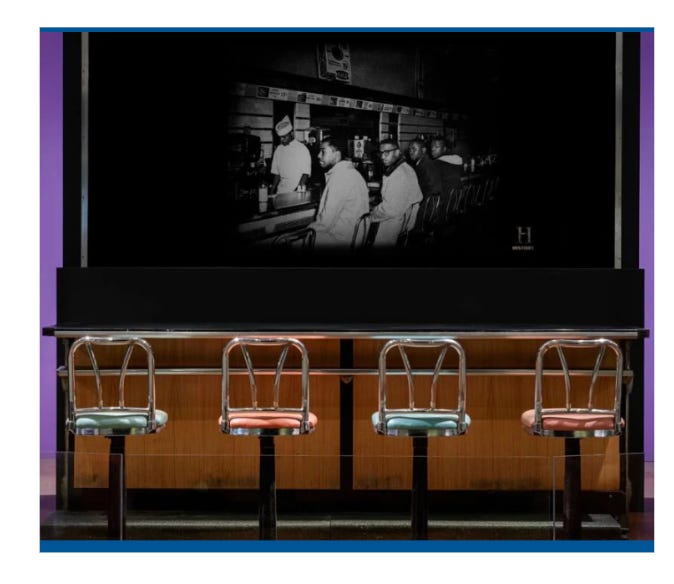
So much stuff, as Congresswoman Melanie Stansbury (D-NM) demonstrated when defending the Smithsonian at a House Oversight and Government Efficiency subcommittee hearing Curators use those artifacts to document our past and construct a narrative, the story of all of us. There are a lot of threads woven into our national tapestry.
QUILTS are another leitmotif. As readers know, I chose the title PINK THREADS to tie together snippets of history, to center female handcrafts, to acknowledge the link between the cotton trade and slavery, to knit a narrative, to employ mending as a metaphor for how women can connect communities. Because of my title graphic and my admiration for quilts, as art, craft and comfort, I’m alert to references to them.
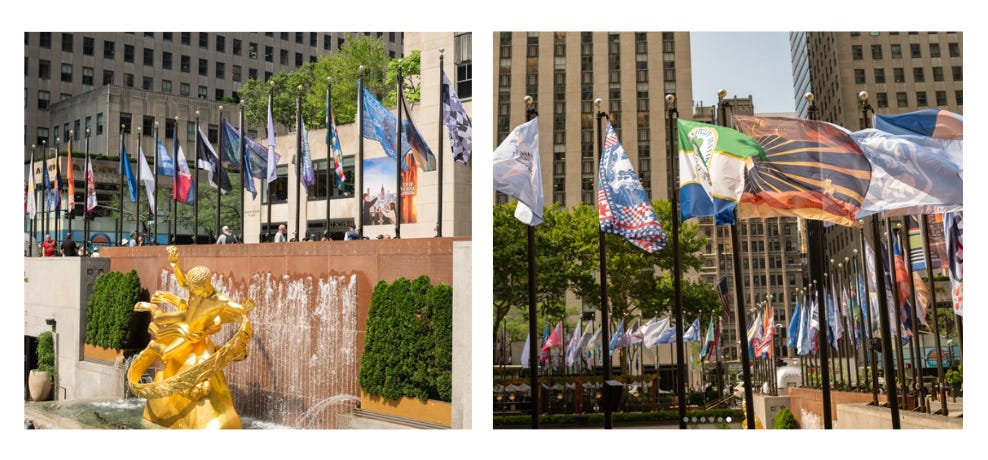
I just learned that in honor of the 250th anniversary of the Declaration of Independence, the CFDA (Council of Fashion Designers of America), Vogue and America250 (as distinct from Freedom250, Trump’s substitute) commissioned designers to reinterpret the flags of the fifty states, five territories and Washington, DC, plus more with Vogue’s logo. Several were fashioned into quilts for a Vogue photo shoot in Utah.
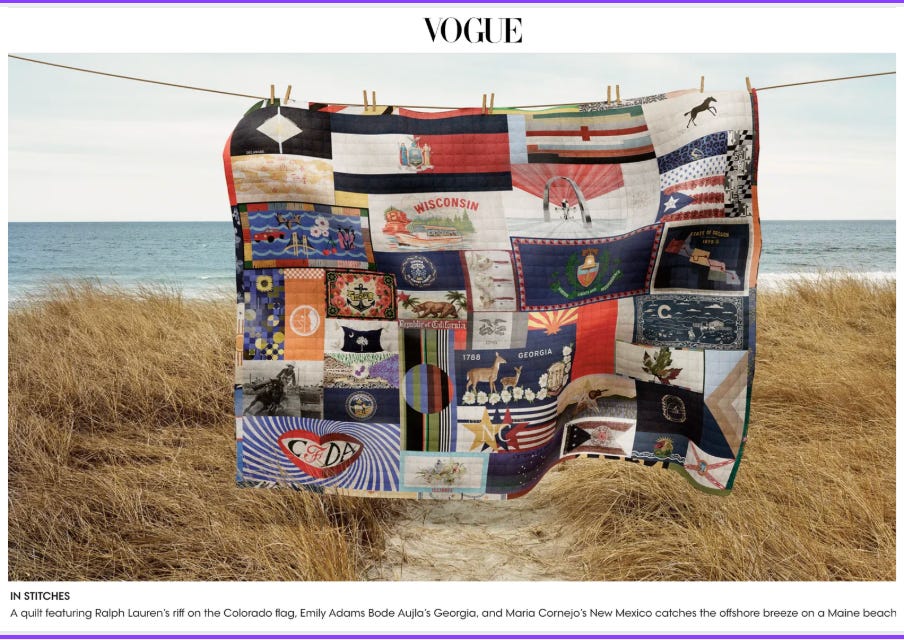
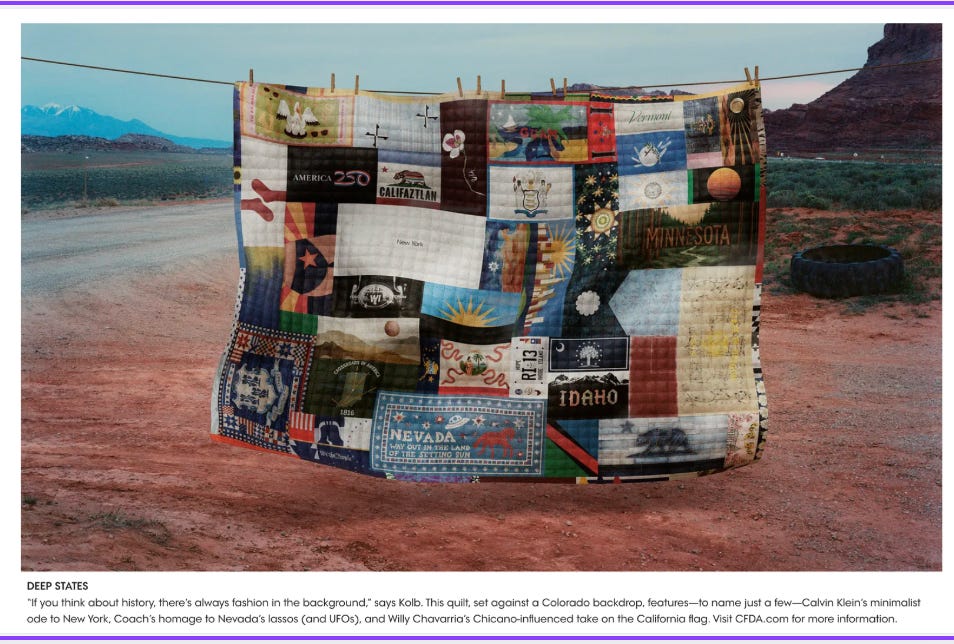
To me, those quilts were more impressive than the individual flags, which will fly around the rink at Rockefeller Center, from July 27 until September 4. America250: United Flags of Fashion will be donated to SCAD (Savannah College of Art and Design).
FINALLY
Former Washington Post tech journalist Taylor Lorenz was recently interviewed by Substack’s new initiative, Model Behavior, about using AI. Full disclosure, Taylor is the granddaughter of my mentor, historian and inventor Anne Madonald, my first boss and stand-in grandmother for my children after my mom died. She made their Halloween costumes and attending school assemblies. Anne was the most tech-savvy early-adaptor I knew, teaching other seniors new skills in her retirement.
Taylor uses AI in aggregating research, organizing information, producing and editing her podcasts, transcribing, selecting headlines, publishing and generating new topics. She recommends full disclosure of AI use by authors to audiences.
My full disclosure: I avoid AI. I try not to use sources generated or summarized by AI. What you read in PINK THREADS is what I wrote, without the assistance of artificial intelligence.
Please support my efforts by subscribing, sharing, upgrading to paid, and continuing to comment about PINK THREADS.
Thank you. ONWARDS!
But if Darline Graham is anything like her brother, I’d vote for her opponent.
I know I should be hoping for another woman in the US Senate