

MAY 30: MEMORIAL DAY

Note: As faithful PINK readers know, there are maybe six essays I revise and reprise annually, because I believe those topic are worth revisiting.
Before Congress passed the Uniform Monday Holiday Act, in 1968, Memorial Day was called Decoration Day and celebrated on May 30, rather than the third Monday in May. Only Independence Day, July 4, and Veterans Day, “the eleventh hour of the eleventh day of the eleventh month,” November 11, the date of the Armistice ending the Great War in 1918, remain sacrosanct.
Memorial Day is rooted in the Civil War, fought over the South’s insistence on its right to enslave Black people. America’s deadliest conflict killed an estimated 620,000 Union and Confederate soldiers and hundreds of bystanders. It left behind a nation of widows, many of whom played roles in memorial commemorations. For fifty years, based on the politics of race, the event was regionally divisive.
Many people have been credited with establishing a Memorial Day. Mary Ann Williams, the widow of a Confederate officer, merged the Columbus, Georgia, Soldiers Aid Society with other local groups across the South, to become the Ladies’ Memorial Association. As its secretary, in March 1866, Williams sent an open appeal to regional newspapers. Signed “A Southern Woman,” it call for held cleaning and decorating the graves of “our gallant Confederate dead,” on a day “set apart annually for its especial attention.” “Flowering graves” was a Southern tradition.
In Columbus, Mississippi, ladies decorated both Confederate and Union graves, inspiring a poem by abolitionist Francis Finch. “The Blue and the Gray,” published in The Atlantic Monthly in 1867, urged forgiveness and reconciliation. Instead, Southern commemorations enshrined ante-bellum culture. The United Daughters of the Confederacy, the 1894 outgrowth of the Ladies’ Memorial Association, enshrined myths of the cavalier South, the happy slave and the “Lost Cause.” The UDC erected hundreds of Confederate memorials, from 1895-1965.
In 1874, Georgia established the first Confederate Memorial Day. Other states followed, without a uniform date. Alternatives included April 26, the day Joseph Johnston surrendered the Army of Tennessee to Union General William Tecumseh Sherman in 1865; May 10, the day Thomas “Stonewall” Jackson died in 1863; and June 3, the birthday of Jefferson Davis, president of the Confederate States of America.
Meanwhile, in Waterloo, NY, in 1865, pharmacist Henry Welles suggested that the town honor both living and dead veterans. His proposal was ignored until a local hero, Union General John Murray, enthusiastically endorsed it, hosting an event on May 5, 1866. A century later, the U.S. Congress recognized Waterloo as “the birthplace of Memorial Day.”
Yale historian David Blight argues that formerly enslaved Black workmen held the first memorial observation. On May 1, 1865, protected by Union infantry, including three regiments of U.S. Colored Troops, they reinterred and decorated the graves of 200 Union prisoners of war in Charleston, SC. Soon after, white leaders in Augusta, Georgia, barred African Americans from decorating Union graves. That prohibition spread.
In 1868, Union General John A. Logan, then commander in chief of the Grand Army of the Republic, a politically powerful, fraternal organization of Union veterans, called for a national celebration on May 30, a date with no historic associations. Speaking to the GAR, Logan reported that “traitors in the South . . . [mark] the graves of rebel soldiers.” He called for a public holiday, “for the purpose of strewing with flowers or otherwise decorating the graves of comrades who died in defense of their country during the late rebellion, and whose bodies now lie in almost every city, village and hamlet churchyard in the land.”
The first national Decoration Day was celebrated on May 30, 1868, in 183 communities in twenty-seven states of thirty-seven in total. General and Mrs. Ulysses S. Grant presided at Arlington National Cemetery. Another Union general and future president, Ohio Republican Congressman James Garfield declared that the graves before them “summed up and perfected . . . the highest virtues of men and citizens. For love of country they accepted death.” He asked the 5,000 guests to decorate the 20,000 graves with flowers.
Since 1948, when President Truman ordered a “Flags In” operation, flags have replaced flowers. The 3d U.S. Army Infantry Regiment puts a flag one boot-length in front of more than 260,000 headstones and at the columbarium of 7,000 niches at Arlington National Cemetery.
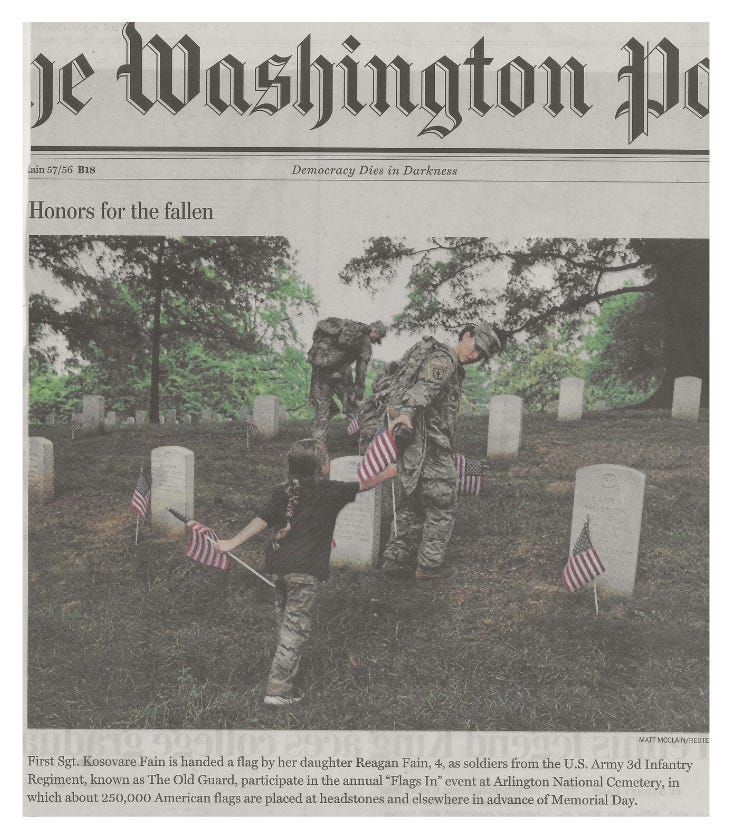
The 3d U.S. Infantry Regiment, traditionally known as The Old Guard, is the Army’s oldest active infantry unit, having served since 1784, in campaigns against Native Americans on the Ohio frontier to the Battle of the Bulge in World War II. It also guards the Tomb of the Unknown Soldier and provides funeral support at Arlington.
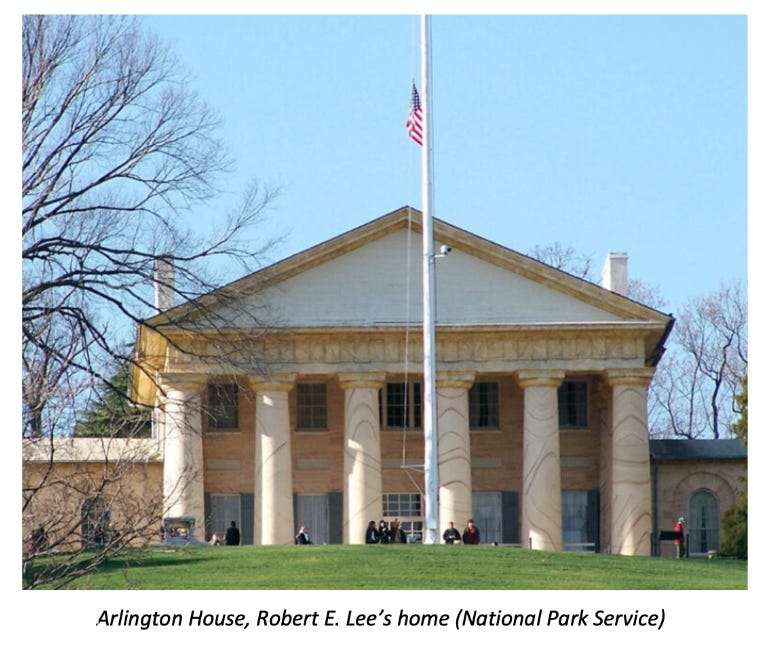
The immediate issue for Civil War burials was identifying bodies. As Drew Gilpin Faust describes in This Republic of Suffering: Death and the American Civil War, there was no system: no dog tags, no official burial location records. In 1862, Congress established the first military cemeteries. Among those was Arlington, established in 1864, on a plantation owned by Robert E. Lee’s wife. Mary Anna Custis Lee had inherited it from her great grandmother, Martha Washington.
The scale of carnage was unimaginable. Until the U.S. National Cemetery System began constructing cemeteries for Union dead, in 1865, body disposal was a local problem. It took four malodorous months to bury 7,000 corpses at Gettysburg, not counting dead horses. President Lincoln would dedicate and consecrate, those hallowed graves, “that from these honored dead we take increased devotion to that cause for which they gave the last full measure of devotion. . . a new birth of freedom.”
Speaking at Arlington on May 30, 1871, Frederick Douglass insisted that the nation remember Lincoln’s words and the war’s purpose. In front of President Grant and his cabinet, the Black orator hoped that Union dead would be honored not only for valor but for the cause they defended. “They died for their country,” he repeated twice, fighting for “the hope of freedom” and against “the hell-black system of human bondage.”
Instead, the country abandoned Reconstruction, the Klan terrorized Black citizens and the Supreme Court institutionalized segregation. Animosity between Union and Confederate veterans over the causes and consequences of the war remained intense. West Point refused to acknowledge alumni deemed traitors.
The ten-week Spanish-American War in 1898 united former combatants in America’s first international conflict since before the Civil War. Because the Senate was controlled by Southerners, President McKinley traveled 2,000 miles across the Deep South, to secure support for ratification of a peace treaty. In Atlanta, the Union veteran announced federal funding for Confederate cemeteries, since “these heroic dead” represented “American valor.” McKinley anticipated the nation’s need for a unified military.
An inventory of Confederate graves at Arlington revealed 136 scattered markers. The Confederates who counted them were offended that their markers were identical to those of the formerly enslaved who had died fighting for the Union. In 1900, Congress approved the reburial of Confederate dead in a separate section of Arlington. Daughters of the Confederacy objected to accepting such “charity” from Yankees. They lost that round but won erecting a Confederate memorial inside the national cemetery.
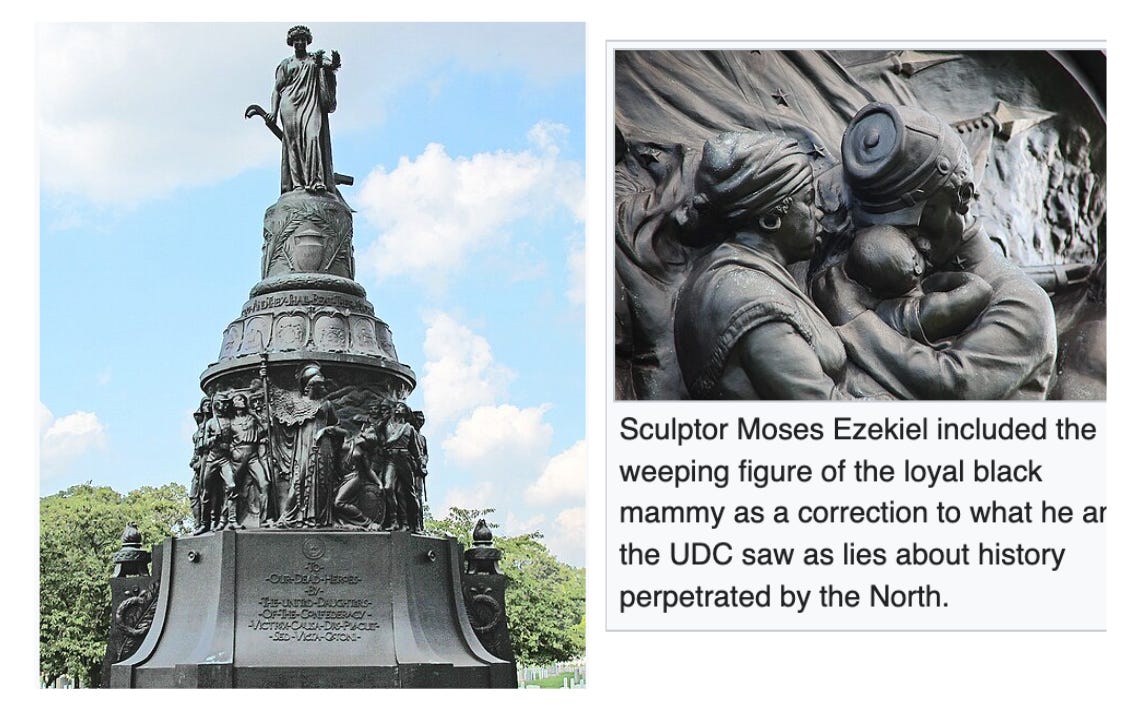
Authorized by Congress in 1906, the monument and designed by Confederate veteran and sculptor Moses Jacob Ezekial, the thirty-two-foot high monument is topped with a woman representing the South. She holds a victor’s wreath and a plowshare. Among the figures surrounding the base are a Negro mammy holding her master’s children and “a faithful Negro body servant following his young master to war.”
It was unveiled by President Wilson in 1914, on Jefferson Davis’s birthday. The former Confederacy still refused to commemorate their dead on May 30.
The history of Memorial Day chronicles regional rather than racial reconciliation. In July 1913, on the fiftieth anniversary of Gettysburg, 50,000 frail white veterans held a four-day Blue and Gray Reunion at the Pennsylvania battlefield. Sectional animosities lingered. Confederates carried battle flags and wore uniform gray jackets with military hats, while the victors wore civilian attire.
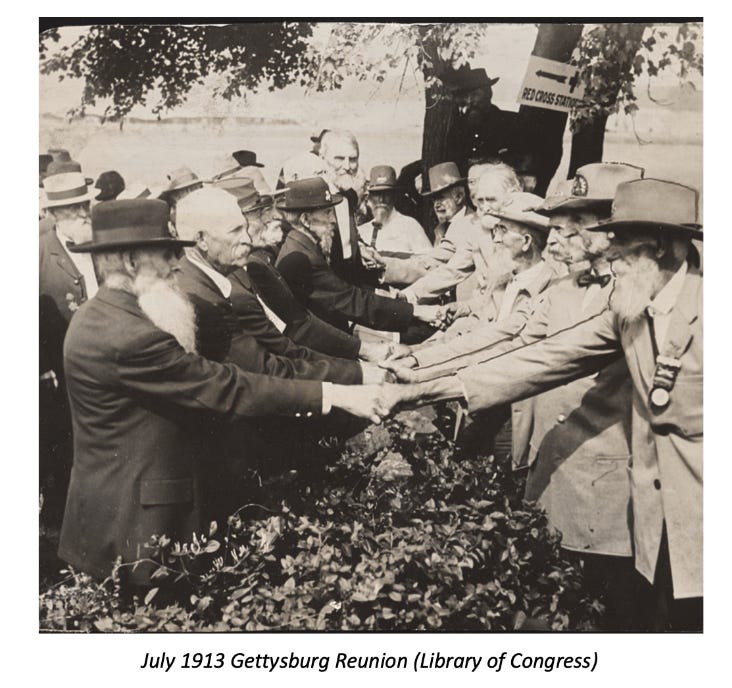
Newspapers described a gathering unified by respect for the bravery of the dead, whether they were heroes, traitors, enslavers or conscripts. Addressing “what it costs to make a nation – the blood and sacrifice of multitudes,” President Wilson was “not once . . . interrupted by a handclap or a cheer.” There were no African American participants. At a Half Century Exposition and Lincoln Jubilee in Chicago, delayed until 1915, Black citizens marked the fiftieth anniversary of the Emancipation Proclamation.
On Decoration Day 1917, race riots in St. Louis prompted white Republican Congressman Leonidas Dyer to draft the country’s first anti-lynching law. On May 30, 1921, a white mob ransacked, burned, bombed and destroyed the prosperous Black neighborhood of Greenwood in Tulsa, Oklahoma. News of the massacre was censored and later erased. On Memorial Day 1922, at the dedication of the Lincoln Memorial, Black guests were seated in a segregated section behind Confederate veterans.
Today, on Memorial Day observed, presidents lay wreaths at the Tomb of the Unknown Solider and veteran Rolling Thunder motorcyclists roar through DC. Small towns stage civic ceremonies and families decorate graves. Fewer than one in ten Americans participate in a Memorial Day observation. In 1913, veterans were already alarmed by young people engaging in “games, races and revelry” rather than “a day of memories and tears.” Now the holiday marks the start of summer. To emphasize its meaning, the American Legion and Veterans of Foreign Wars have lobbied to restore the May 30 date and underwrite media campaigns.
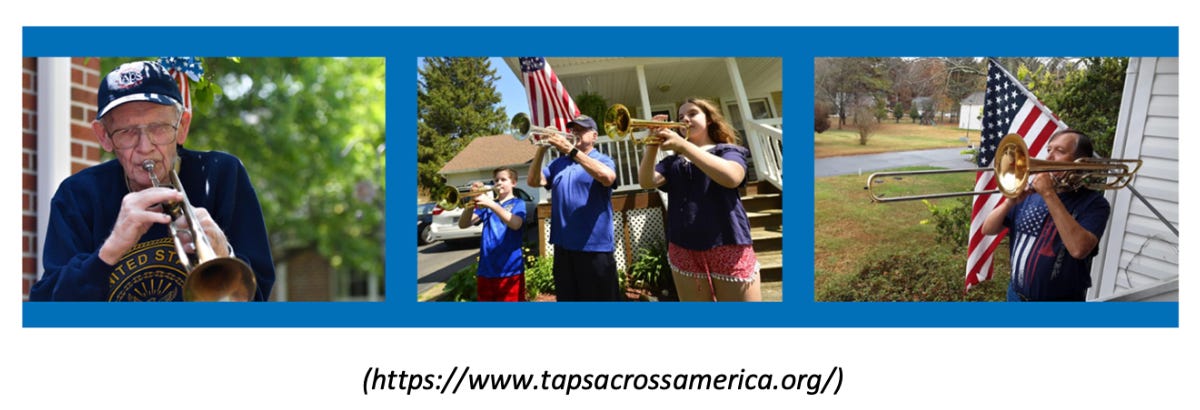
In 2000, the National Moment of Remembrance Act called for a moment of silence at 3:00 pm on Memorial Day. Few Americans know about it. In 2015, retired Air Force bugler Jari Villanueva launched Taps Across America, asking volunteers to play “Taps” following the moment of silence. More than 10,000 musicians joined the national salute.
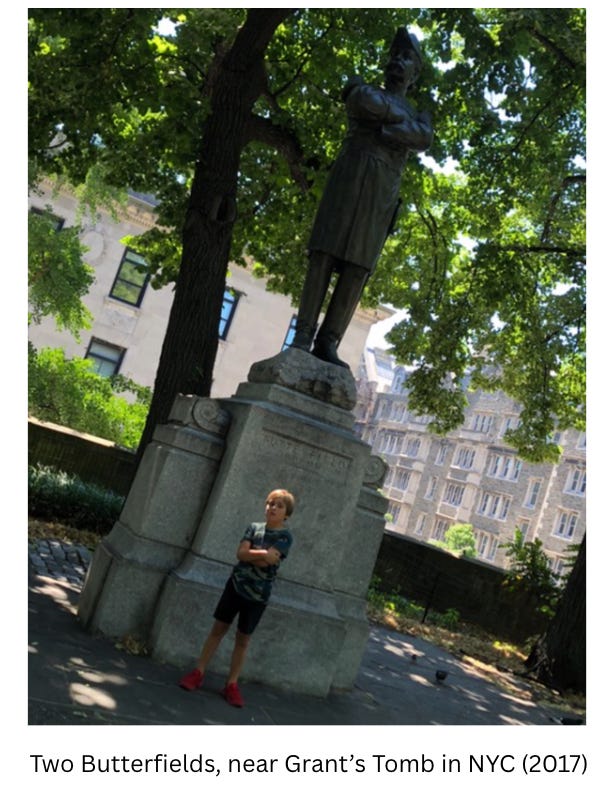
(Family footnote: Union Brigadier General Daniel Butterfield is credited with composing the twenty-four-note “Taps,” in 1862. It replaced the French-derived “Lights Out” and was soon adapted by troops on both sides. Butterfield earned the Medal of Honor for his gallantry at the Battle of Gaines’ Mill, Virginia, where, after he’d lost 600 soldiers, he rallied the remnants, despite being wounded. He also designed the system of “corps badges” used to identify different army divisions. My son-in-law’s family has always claimed Daniel Butterfield was their great great etc grandparent, but I have only found one reference, among many, to one son. The General was buried at West Point.)
Watching George Floyd die, at the hands of four white Minneapolis police officers, on Memorial Day Monday, 2020, horrified, outraged and energized the country. Within two weeks, in 550 communities, 500,000 people demonstrated. That summer, between fifteen and twenty-six million people marched in every state, in 5,700 initiatives to support Black civil rights, including prominent Republicans. For the first time, according to the General Social Survey conducted by the University of Chicago, a majority, 55% of Americans, agreed that discrimination was the main reason Black people had worse jobs, poorer housing and less income than whites.
George Floyd’s murder and the 2020 Black Lives Matter protests prompted national reconsideration of our history and culture. Pancake mixes, streets, schools, sports teams, country bands and bird species were renamed. Whites learned about Juneteenth. Confederate statues were removed, including from Arlington Cemetery. That action and renaming ten army bases, which honored Confederate traitors, were recommended by the Pentagon’s 2022 Naming Commission, a decision Secretary of Defense Hegseth has attempted to reverse.
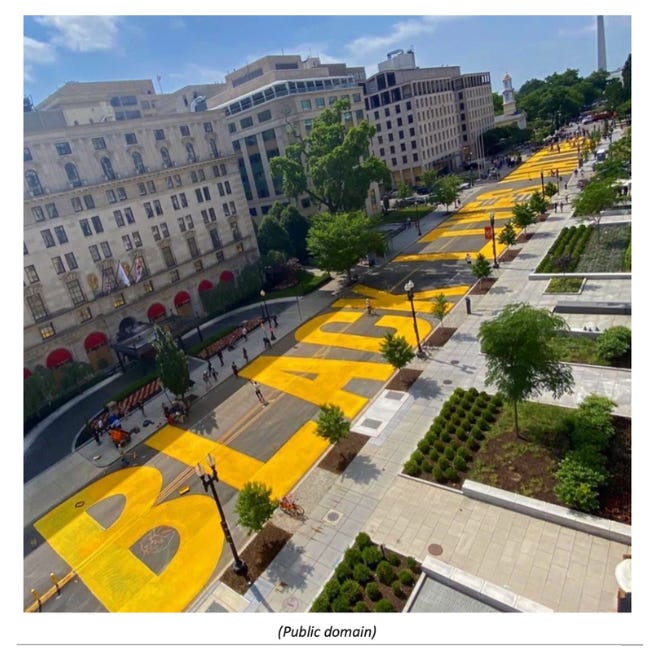
(Another family footnote: My son was among the volunteer artists who joined the DC Department of Public Works, to paint BLACK LIVES MATTER in bright yellow, 35-foot tall, bold font letters, transforming two-blocks of Sixteenth Street, just north of Lafayette Park and the White House, into a pedestrian plaza. In 2025, the mural was removed with jackhammers.)
I wish more Americans knew the deep connection of Memorial Day to the war fought to end slavery. America may have emancipated the enslaved, but it hasn’t overcome resistance to civil rights, including efforts to disenfranchise Black voters. In addition to playing “Taps,” perhaps every Memorial Day celebration should include reading Abraham Lincoln’s Gettysburg Address and James Garfield’s and Frederick Douglass’s Memorial Day speeches.
Whether marked on a long weekend Monday or on May 30, Memorial Day should be meaningful, and remind us that democracy has been secured and advanced by sacrifice for 250 years.
SOURCES:
Photographs: Public domain as noted.
Richard Gardiner and Daniel Bellware, The Genesis of the Memorial Day Holiday (Columbus [GA] State University, 2014).
Gillian Brockwell, “Does Memorial Day Have Origins in the Decoration of Confederate Graves?” Washington Post (May 25, 2024), https://www.washingtonpost.com/history/2024/05/25/memorial-day-start-origins-confederates/
“The History and Origin of Memorial Day in Waterloo, NY,” https://waterloony.com/memorial-day/history/
James Garflied’s role: “First Official National Decoration Day,” https://www.nps.gov/articles/first-official-national-decoration-day.htm
History.com Editors, “Memorial Day” (October 27, 2009) https://www.history.com/topics/holidays/memorial-day-history
David W. Blight, Frederick Douglass: Prophet of Freedom (Simon & Schuster, 2018).
Drew Gilpin Faust, “They Died for the Promise of America,” New York Times (May 26, 2025), https://www.nytimes.com/2025/05/26/opinion/memorial-day-democracy-crisis.html
Eric Kayne, “’Every Headstone Tells a Story:’ Army’s Old Guard Places 260,000 Flags at Arlington Cemetery in Advance of Memorial Day,” Stars and Stripes (May 22, 2025), https://www.stripes.com/branches/army/2025-05-22/army-old-guard-flags-arlington-memorial-day-17877805.html
Drew Gilpin Faust, This Republic of Suffering: Death and the American Civil War (VintageRandom House, 2008).
John L. Hopkins, The World Will Never See Its Like: The Gettysburg Reunion of 1913 (Savas Beatie, 2023).
Thomas R. Flagel, War, Memory and the 1913 Gettysburg Reunion (Kent State University Press, 2019).
Willian A. Blair, Cities of the Dead: Contesting the Memory of the Civil War in the South, 1865-1914 (University of North Carolina Press, 2004).
Daniel Butterfield: https://www.tapsbugler.com/daniel-adams-butterfield/
Shayla Dewan, “Five Years Later, Right Reframes Killing of Floyd,” New York Times (May 25, 2025), https://www.nytimes.com/2025/05/24/us/george-floyd-derek-chauvin-republicans.html
Akilah Johnson and Scott Clement, “Five Years After Floyd’s Murder, Racial Reckoning Has Stalled,” Washington Post (May 25, 2025), https://www.washingtonpost.com/nation/2025/05/24/george-floyd-murder-dei-police-reform/
Elisabeth Griffith, FORMIDABLE: American Women and the Fight for Equality, 1920-2020 (Pegasus, 2022).