

OPENING DAY 2026:
A LEAGUE OF THEIR OWN

According to pollsters, spring is Americans’ least favorite season. I love it, because Washington is awash in cherry blossom pink. It offers another fresh start, like New Year’s Day or the first day of school. March 26 was Major League Baseball’s Opening Day, the earliest date ever, due to Passover this week.
Opening Day for the new Women’s Pro Baseball League (WPBL) will be August 1. Established in 2024, the WPNL held tryouts in August 2025. In November, 131 players participated in a virtual draft, resulting in four teams of fifteen players. They will play a seven-week season for Boston, Los Angeles, New York and San Francisco, the four largest MLB markets.

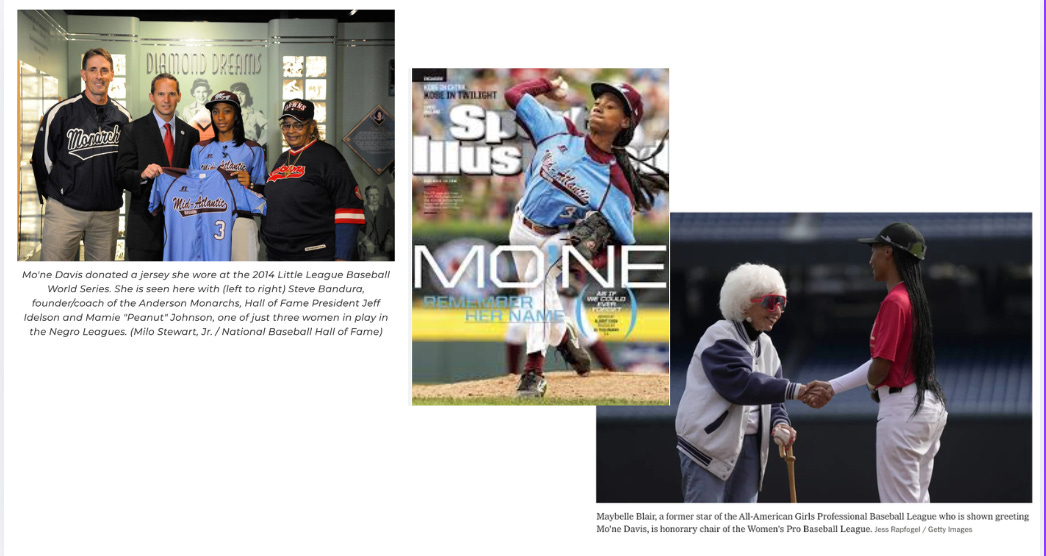
Among the women players is Mo’ne Davis, who threw a shut out in the 2014 Little League World Series at age thirteen. Her fast ball clocked at 70 m.p.h. The Philadelphia native was the eighteenth girl to play in the championships, the sixth to get a hit and the first Little Leaguer to appear on the cover of Sports Illustrated, bumping Kobe Bryant. Davis donated her Anderson Monarchs jersey to the Baseball Hall of Fame, accompanied by teammates and Mamie Johnson, who had played in the Negro Baseball League.
Girls could play on boys and coed teams thanks to a 1972 lawsuit. Little League Baseball began in 1939 without many rules, but in 1951, it added, “Girls are not eligible under any conditions.” In 1972, Maria Pepe, who was twelve, played three games with her Hoboken team, until her coach removed her rather than risk losing the team’s Little League status.
Pepe’s dismissal drew press coverage and an offer from the National Organization for Women, to sue on her behalf. In 1974, the New Jersey Superior Court ordered the removal of the gender restriction from the Little League charter. By then the Congress had passed Title IX.
To coincide with the 2014 World Series, Spike Lee produced a sixteen-minute documentary and a shorter Chevrolet commercial, Mo’ne Davis: Throw Like a Girl. Davis threw out the ceremonial first pitch for game four. She used her fame to raise money for globally impoverished girls and played softball for Hampton University before pursuing a graduate degree in sports management at Columbia University. In August she’ll play for Los Angeles.
Kelsie Whitmore, the only girl on her Little League team in California and former U.S. national team pitcher, was the WPBL’s first overall draft pick. She plays for the Savannah Bananas, a barnstorming baseball team. It will remain her home base when she is not playing for the San Francisco WPBL.
“Women have always played baseball,” declared WPBL co-founder and Commissioner, Justine Siegal, PhD. “From backyard games . . . to rec league across the country, women have found ways to play. . . Baseball is America’s Pastime, but the professional game hasn’t evolved to reflect the diversity of those who play, watch and love this sport. That’s about to change.”
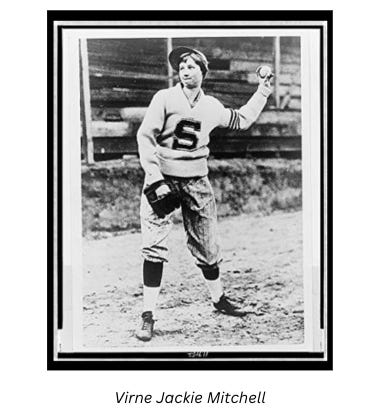
Siegal is a multiple “first:” the first woman to coach a men’s pro baseball team, in the Canadian American League, in 2009; the first to throw batting practice for an MLB team, in 2011; the first to coach an MLB team, in 2015. There have been others: owners, umpires, pitchers on men’s teams. Virne Jackie Mitchell Gilbert (1913-1987) struck out Babe Ruth and Lou Gehrig in a 1931 exhibition game, when she was seventeen.
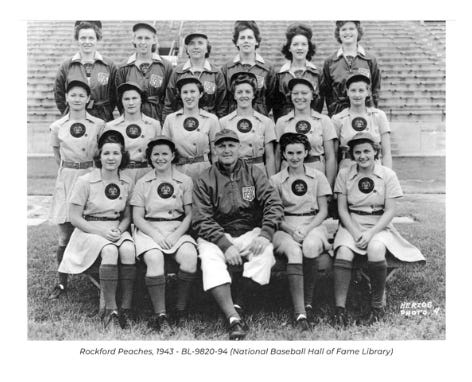
The WPBL is not America’s first women’s professional baseball team. In 1943, Philip Wrigley, who manufactured chewing gum and owned the Chicago Cubs, launched the All-American Girls Professional Baseball League (AAGPBL). He hoped female athletes, playing a combination of softball and baseball, would attract fans to empty stadiums. These “lipstick league” players were enormously popular, especially in small towns. In 1948, attendance hit one million fans.
That women were undertaking all kinds of new roles during the Second World War made acceptance easier. Men enlisted and women relocated for jobs in war industries or in the government. While most Black women were already employed, the war offered more appealing options. Dislocation disrupted traditional attitudes about women’s economic and social roles, including their participation in professional sports.
On January 15, 1942, when President Roosevelt gave MLB Commissioner Kenesaw Mountain Landis the “green light” to keep baseball going for the good for the country, he may not have anticipated women playing pro ball.
Ignoring the risk of injuries to bare legs, Mrs. Wrigley designed a short-skirted uniform with satin underpants, baseball socks and caps. She hired Helena Rubenstein’s salon to provide lessons in makeup and manners. Because competition and sweating were considered unfeminine, off the field, players were required to wear skirts and heels. During the National Anthem, opposing teams formed a “V for Victory.” Representing the “All-American girl next door,” the League did not recruit Black players.
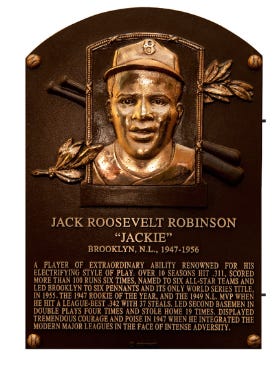
After Jackie Robinson broke the color barrier in MLB, on April 15, 1947, starting on first base for the Brooklyn Dodgers, an exodus of talent decimated the Negro National League, which folded in 1948. The four remaining teams became American Negro League. Denied the chance to play in the AAGPBL, three Black women played with men in the ANL.
To attract fans, owners planned stunts, like the ones later employed by the Harlem Globetrotters. The Indianapolis Clowns fielded three talented women, who did not need tricks: Toni Stone, Mamie “Peanut” Johnson and Connie Morgan. They refused to wear skirts.
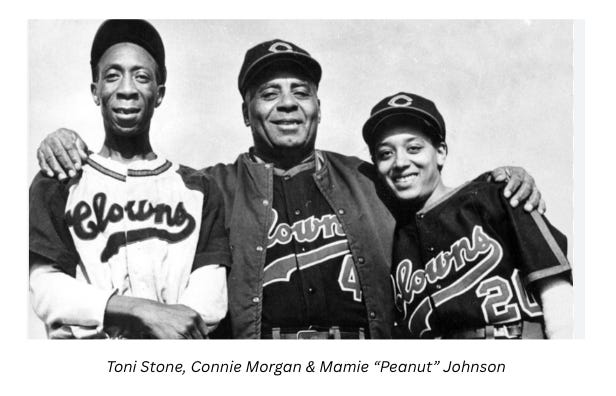
As the first, Stone faced resistance and sabotage from male teammates. She changed in the umpire’s office. Because hotel proprietors assumed she was a whore traveling with the team, they directed her to local brothels, where she was welcomed. She transferred from Indianapolis to the Kansas City Monarchs before retiring in 1955.
The Indianapolis team recruited Mamie Johnson in 1954. Nicknamed “Peanut” because she was petite, she was the first female professional league pitcher. Connie Morgan was hired to replace Stone. At nineteen, she had played pro ball for five years. The New York Amsterdam News confirmed their talent: “The girls take a back seat to no one on the field.”
White female professional baseball players were banned after 1952. Black women played a little longer. All of them were eventually represented in the Baseball Hall of Fame (BHF) in Cooperstown, NY. The village was incorporated in 1807 by the father of American novelist James Fenimore Cooper. The BHF was established in 1939 by the heirs of Edward Clark, who helped Isaac Singer patent the sewing machine.
In 1985, the newly named Chief Curator for the museum was given some AAGPBL baseball cards, prompting to consider an exhibit about women ballplayers. But when an LA Times reporter asked about an exhibit, the curator admitted they did not have enough artifacts to create one.
The reporter printed his response. Three weeks later, he got a letter from Dottie Collins, a former Rockford Peach who worked with the AAGPBL Alumnae Association. With its help, the museum opened its permanent Women in Baseball exhibit and inducted over 150 former players into the Hall of Fame on November 5, 1988. In 2006, the museum opened “Diamond Dreams,” an expanded exhibit.
A 1987 documentary about the AAGPBL, A LEAGUE OF THEIR OWN, caught the attention of Penny Marshall, who commissioned a screenplay and directed the 1992 movie with the same title. The sports comedy focused on the Peaches and starred Geena Davis, Lori Petty, Rosie O’Donnell, Madonna and Tom Hanks. As team manager, he utters the classic line, “There ain’t no cryin’ in baseball.” Forty-seven former players attended its opening in New York City.
In 2022, Amazon Prime released THE AMAZING TRUE STORY OF A LEAGUE OF THEIR OWN, which included interviews with players and addressed issues of racism in the league and the sexual orientation of its players.
ENDNOTES
Jackie Robinson (1919-1972) had served as a lieutenant during the WWII. Committed to the “Double V” campaign (victory against fascism abroad, victory against racism at home), for refusing to move to the back of an Army bus, he was court martialed and acquitted. Writing twenty-five years later, Robinson observed, “I cannot stand and sing the National Anthem. I cannot salute the flag. I know I am a Black man in a white world.” In its obituary, the New York Times concluded: “For sociological impact, Jack Roosevelt Robinson was perhaps America’s most significant athlete.” His lifelong battle for civil rights and equality transcends his athletic career.
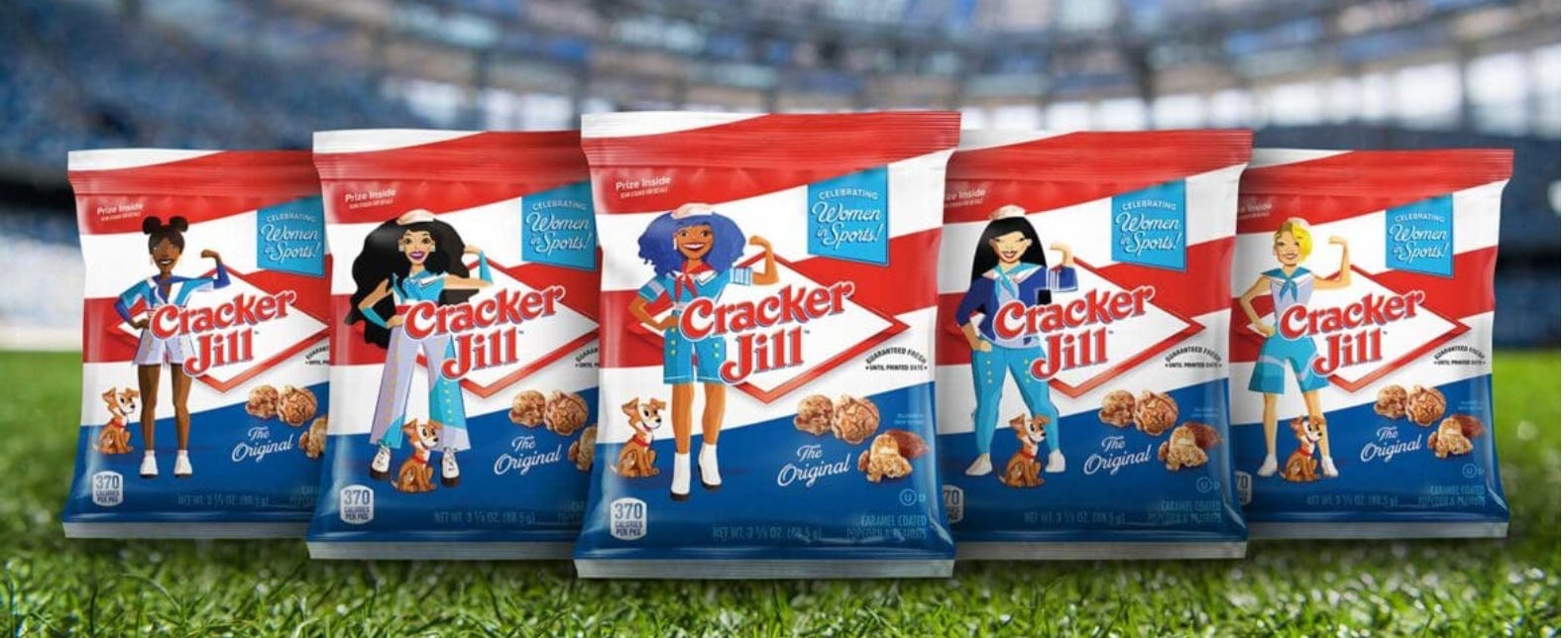
For opening day in 2022, Frito-Lay, owned by PepsiCo, marketed CRACKER JILLS, a limited-edition snack identical to Cracker Jacks except for its name, packaging and mascot. It was created to promote and support the women’s Sports Foundation. The Jills’ tagline was about role models: “Sometimes all it takes to believe you can do something is to see someone who looks like you do it first.
SOURCES
Photo credits: public domain or Baseball Hall of Fame.
Jordy Fee-Platt, “Women’s Pro League Is Here, and New York Gets One of the First Four Teams,” New York Times (October 22, 2025), https://www.nytimes.com/athletic/6734910/2025/10/21/womens-baseball-league-ny-la/
Anna Wade, “#Shortstops: Maria Pepe Changes the Face of Little League Baseball,” https://baseballhall.org/discover/short-stops/nothing-little-about-it
Samantha Carr, “Before a League of Their Own,” https://baseballhall.org/discover-more/stories/baseball-history/there-is-crying-in-baseball
Bill Francis, “League of Women Ballplayers,” https://baseballhall.org/discover-more/stories/baseball-history/league-of-women-ballplayers
John Rosengren, “Toni Stone, Connie Morgan and Mamie Johnson Blazed a Trail for Women in the Negro Leagues,” https://baseballhall.org/discover/baseball-history/toni-stone-connie-morgan-and-mamie-johnson-blazed-trail-for-women-in-negro
Dave Anderson, “Jackie Robinson, First Black in Major Leagues, Dies,” New York Times (October 25, 1972), https://www.nytimes.com/1972/10/25/archives/jackie-robinson-first-black-in-major-leagues-dies-jackie-robinson.html
Elisabeth Griffith, FORMIDABLE: American Women and the Fight for Equality, 1920-2020 (Pegasus, 2022).
Thanks Betsy. Once again you filled in the gaps that I didn't realize existed.
This is a wonderful piece, Betsy! Spring, indeed! Aggie